Sunday, June 11, 2006

Episcopal Church and Visual Arts Exhibit

Linking my way through the Anglican/Episcopal internet, I found a link on the Episcopal Church home page to Faces of Christ gallery, "in collaboration with ECVA.org".

Which is? Apparently The Episcopal Church and Visual Arts. *That* links to Visual Preludes 2006, which is described as "a gift to the 75th General Convention of the Episcopal Church, Columbus Ohio, June 13-21 2006". So you see, I haven't *really* strayed off topic/gotten distracted by something shiny. It's all connected--isn't that cool?

While I was looking through these links, I was also listening to the orientation video that is provided for people who will be deputies to the General Convention. Much focus on pacing yourself, getting enough rest, being prepared to do a lot of walking, etc. So it also occurs to me that looking at these images can be restful and replenishing, which has got to be a Good Thing.


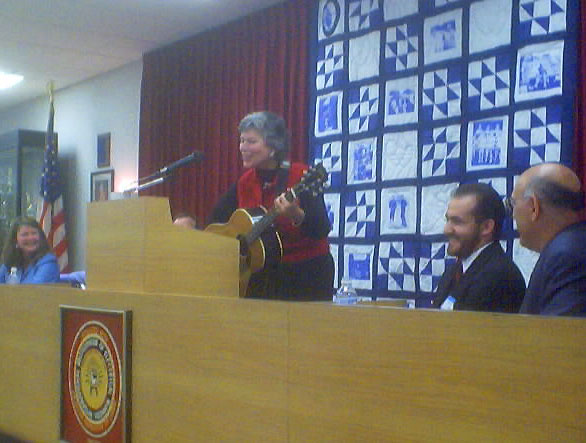
The image you see above is Centering by Ginny Runge, and is from the Wisdom of God gallery.

Which of these images speaks to you?

Alternate link for comments

Columbus Dispatch on the "other issues"

The Columbus Dispatch has an article about the General Convention in this past Friday's Faith and Values section, entitled Church confronts choice: Sexuality dispute tops agenda as thousands gather. Yes, I suppose the average "person on the street", if they know anything about the convention, know that the "sexuality dispute" is going to be addressed. They may also be aware that a new Presiding Bishop is to be chosen. What people probably know the least about is the "other issues that will be addressed", so that's what I'll excerpt here. To read the full article, click here. (There is also an article about Bishop Robert Duncan of Pittsburgh, leader of the conservative Anglican Communion Network.)

Other issues that will be addressed include:

• Choosing a new president of the House of Deputies to replace the Rev. George Werner of Pittsburgh, who was not re-elected as a deputy for his diocese. He has been president since 2000.

• Affirming the church’s support for the U.N. Millennium Development Goals, aimed at battling poverty, hunger and HIV/AIDS, improving education and health care, and reducing child mortality.

• Taking a step toward full communion with the United Methodist Church by approving joint Eucharist.

• Apologizing for the church’s support of slavery and for racial discrimination after emancipation. This proposal also calls for a study to determine whether reparations should be paid to black Episcopalians.

• Affirming that evolution theory "is entirely compatible with an authentic and living Christian faith."

• Calling for an end to the U.S. sanctions against Cuba.

• Considering resolutions on the Middle East, including reaffirming the church’s commitment to ending anti-Semitism, working for the assurance of human rights of Palestinians and recognizing Jerusalem as the shared capital of Israel and a Palestinian state.
Alternate link for comments

General Convention update

After the General Convention in 2003, I attended a forum at St. James Episcopal Church in Columbus. Part of that was a report called something like "What happened at Convention that *wasn't* reported on CNN". And indeed there were plenty of things that happened at the convention in 2003 that by all rights should have been considered "newsworthy" but that I'd never heard about.

So, part of my purpose in blogging about GC 2006 is to help provide a more complete picture than the mainstream media coverage which, in all likelihood, will focus on contentious issues. Such focus is not only incomplete but, in my opinion, both unfair and unbalanced. (Perhaps we can make a game of counting how many headlines we see which include the words " a church in crisis".)

As I mentioned in my earliler post, I've signed up to receive convention updates from the Diocese of Southern Ohio. Here is part of this morning's report from Columbus...

A commissioning service of the volunteer supervisors and coordinators was held on the morning of June 10. More than 60 people -- many from the Diocese of Southern Ohio -- have committed to nearly two weeks of volunteer service to the General Convention and the Episcopal Church. These supervisors will guide the work of more than 1,500 volunteers throughout the course of the convention.

Bishop Kenneth Price Jr., bishop in Southern Ohio, celebrated at the Eucharist service. Debby Stokes, chair of the local arrangements committee for the Diocese of Southern Ohio, offered thanksgiving for the commitment of the volunteers.

The Rev. Gregory Straub, executive officer of General Convention, preached the sermon. He offered these words of advice to the volunteer coordinators: "Maintain love. Be hospitable. Serve one another."
Father Jake Stops the World did a post about General Convention resources, and if you visit that link you can find, among other things, links to blogs that will be covering the convention.

Alternate link for comments

Saturday, June 10, 2006

General Convention 2006

The General Convention of the Episcopal Church is begins this week. I officially joined Episcopal Church shortly after the last convention, which was in 2003, and was excited to learn that the next convention would be right here in Columbus. To have things align like that really caught my attention. I was certain that this must be one of "God's clues", and that I was *meant* to be at that convention.

It's hard to believe June 2006 is here already. Work and family and, well, life have conspired to keep me from focusing my attention on doing the research and writing I'd hoped to do in advance of this convention. Now that the convention is here (I just got my first e-mail update from the Diocese of Southern Ohio), clearly I need to *make* time. But, easing into this today, I will start by just saying "ditto" to what Sarah Dylan Breuer wrote at Dylan's Lectionary Notes:

The Episcopal Church is likely to be in the popular as well as religious media a lot over the next three weeks, and I'm praying that it proves to be an opportunity for evangelism -- for many who don't think they want anything to do with Christianity because they think Christianity is all about Left Behind and the Religious Right to hear about Christians who welcome LGBT people as they are, who care about the environment and oppose war, who are more concerned with "the least of these" than what they imagine other people do in bed. General Convention 2003 was such an opportunity for evangelism for me -- I got to talk with countless complete strangers in the weeks and months following about who Jesus is and what I believe God is up to in the world because people would see my "The Episcopal Church Welcomes You" bumper sticker or the cross I wear and would ask me about General Convention. Whatever else emerges from GC 2006, I'm banking that there will be many similar opportunities following it, and I hope that the media manage to get across some of the breadth and depth of what convention does amidst the inevitable headlines about sex.

Alternate link for comments

Eyes Wide Open Exhibit

From today's Columbus Dispatch

Empty boots at Statehouse to show human cost of war
Nearly 2,500 pairs of empty boots in military formation representing fallen U.S. troops will stretch a full city block across the Statehouse west lawn along High Street — one of the most visible locales in all of Ohio.

For Peggy Logue of Lebanon, whose son Michael served with the Marine Reserves’ Lima Company, 3 rd Battalion, 25 th Regiment, the exhibit is a chance to see up close the cost of a war she thinks has been badly mishandled by the Bush administration.

"We have young people dying, and if we’re over there fighting a war, we better know what we’re doing it for," said Logue, who, along with her husband, Jerry, will speak at the exhibit early Wednesday afternoon.

Sixteen members of Lima Company, many from Ohio, died in Iraq.

Click here for the rest.

Alternate link for comments

Sunday, May 28, 2006

Fred Rogers testifying in Senate hearings, 1969


I first saw this video somewhere a couple days ago, and it was just linked again last night at Firedoglake.

Crooks and Liars has a great clip up from the Senate hearings in 1971 when Nixon wanted to cut the funding for the Corporation for Public Broadcasting in half and Fred Rogers made an impassioned plea that won over his listeners.
The hearings were chaired by Senator John Pastore.

Pastore: All right, Rogers, you've got the floor.

Rogers: Senator Pastore, this is a philosophical statement and would take about ten minutes to read, so I'll not do that. One of the first things that a child learns in a healthy family is trust, and I trust what you have said that you will read this. It's very important to me. I care deeply about children.

Pastore: Will it make you happy if you read it?

Rogers: I'd just like to talk about it, if it's all right. My first children's program was on WQED fifteen years ago, and its budget was $30. Now, with the help of the Sears-Roebuck Foundation and National Educational Television, as well as all of the affiliated stations--each station pays to show our program. It's a unique kind of funding in educational television. Now our program has a budget of $6000.

It may sound like quite a difference, but $6000 pays for less than two minutes of cartoons. Two minutes of animated, what I sometimes say, bombardment. I'm very much concerned, as I know you are, about what's being delivered to our children in this country. And I've worked in the field of child development for six years now, trying to understand the inner needs of children. We deal with such things as the inner drama of childhood. We don't have to bop somebody over the head to make drama on the screen. We deal with such things as getting a haircut, or the feelings about brothers and sisters, and the kind of anger that arises in simple family situations. And we speak to it constructively.

Pastore: How long of a program is it?

Rogers: It's a half hour every day. Most channels schedule it in the noontime as well as in the evening. WETA here has scheduled it in the late afternoon.

Pastore: Could we get a copy of this so that we can see it? Maybe not today, but I'd like to see the program.

Rogers: I'd like very much for you to see it.

Pastore: I'd like to see the program itself, or any one of them.

Rogers: We made a hundred programs for EEN, the Eastern Eduational Network, and then when the money ran out, people in Boston and Pittsburgh and Chicago all came to the fore and said that we've *got* to have more of this neighborhood expression of care.

And this is what I give. I give an expression of care every day to each child, to help him realize that he *is* unique. I end the program by saying, "You've made this day a special day, by just your being you. There's no person in the whole world like you, and *I* like you, just the way you are." And I feel that if we in public television can only make it clear that feelings are mentionable *and* managable, we will have done a great service for mental health.

I think that it's much more dramatic that two men could be working out their feelings of anger--*much* more dramatic than showing something of gunfire. I'm *constantly* concerned about what our children are seeing, and for 15 years I have tried in this country and Canada, to present what I think is a *meaningful* expression of care.

Pastore: Do you narrate it?

Rogers: I'm the host, yes. And I do all the puppets and I write all the music, and I write all the scripts--

Pastore: Well, I'm supposed to be a pretty tough guy, and this is the first time I've had goosebumps for the last two days.

Rogers: Well, I'm grateful, not only for your goosebumps, but for your interest in our kind of communication. Could I tell you the words of one of the songs, which I feel is very important?

Pastore: Yes.

Rogers: This has to do with that good feeling of control which I feel that children need to know it's there. And it stars out,

What do you do with the mad that you feel--and that first line came straight from a child. I work with children with puppets in very personal communication in small groups


What do you do with the mad that you feel
When you feel so mad you could bite?
When the whole wide world seems oh, so wrong...
And nothing you do seems very right?

What do you do? Do you punch a bag?
Do you pound some clay or some dough?
Do you round up friends for a game of tag?
Or see how fast you go?

It's great to be able to stop
When you've planned a thing that's wrong,
And be able to do something else instead
And think this song:

I can stop when I want to
Can stop when I wish
I can stop, stop, stop any time.
And what a good feeling to feel like this
And know that the feeling is really mine.
Know that there's something deep inside
That helps us become what we can.
For a girl can be someday a lady
And a boy can be someday a man.

Pastore: I think it's wonderful. I think it's wonderful! (looking to his side) I think he's just earned the 20 million dollars! (Applause)

Alternate link for comments

Sunday, May 21, 2006

Central Ohioans for Peace

From their web site:

Monday, May 22nd, at 7:00 pm: Speakers: Art and Peggy Gish
We know from experience that Art & Peggy have a lot to tell us about their experiences in Hebron (Art) and Baghdad (Peggy). Basket donations during this meeting will go to the Gishes to support their work in the Middle East.

Alternate link for comments

Saturday, May 20, 2006

St. Stephen's Strawberry Festival


Every now and then, I figure I should plug an event for my own church, because, well, because I've got a blog and I *can*, that's why.

From the parish newsletter:

SAVE THE DATE OF JUNE 4TH AT 3:30 FOR A PARISH EVENT FOR YOUNG AND OLD!

COME TO OUR STRAWBERRY FESTIVAL
Sponsored by the St. Stephen's Choir

The afternoon will begin with a concert at 3:30 p.m.

CELEBRATING
The new Baldwin piano donated by the Williams family in memory of their mother, Helen Williams.
Pentecost, the birthday of the church
The talents of our St. Stephen's instrumentalists and their friends.

The concert will include many instrumental combinations. All selections will highlight our wonderful new piano. After this concert we invite our audience (young and old) to come up to see the instruments (violin, 'cello, flute, bassoon, trumpet, marimba and organ) up close and to ask questions of the instrumentalists. We encourage families to come, as the program will have great variety.

The afternoon will continue with a STRAWBERRY FESTIVAL at 4:15 p.m.

Don't miss the FUN, FELLOWSHIP and FOOD!

A freewill offering will be taken to benefit the choir fund. Donations are welcome.

Alternate link for comments

Thursday, May 18, 2006

Frances Strickland on religion and politics

Last night I attended an event put together by the Central Ohio Coalition of Democratic and Progressive Organizations. Buckeye State Blog has written about it here and here. As I was leaving, I saw Frances Stickland, who had been speaking--and singing--on behalf of her husband Ted Strickland who is running for governor of Ohio. She graciously agreed to give me a couple minutes of her time and answer a couple questions. I asked her what kind of response her husband's campaign is getting from people of faith around the state.


Religion is being put into politics to be divisive, and most people that I know, that are sincere about their faith don't like that. And basically what we want to do is just to try to keep the focus on the things like healthcare that really matter, and the things that have gotten this state in trouble. And to try not to participate in any way that's divisive.
Does Ted ever pull on his background as a minister in responding--
Not much. As a minister, that's one of his fears--that politics is going to hurt the church, rather than the church helping politics, or the political field. He just feels that it can cause congregations to divide...split. Somebody said once, "I think in the future some time we're going to have Democratic churches and Republican churches!" And that really disturbs him.

And so, he can--if somebody asks him about a scripture, he'll know it and respond. He can, but it just needs to be appropriate. He will not deliberately use that to try to make points. It would be just in responding in some way to what somebody's asking.
Alternate link for comments

Wednesday, May 17, 2006

We Believe Columbus meets again May 25

What follows is a message available as a PDF link from the home page of We Believe...

TO ALL PARTICIPANTS IN WE BELIEVE OHIO:
Our next plenary session will be held on Thursday May 25th 9am at First Congregational Church 444 E. Broad Street.

We have had over 120 faith leaders from Central Ohio that have participated in one way or another in the formation of We Believe. We are calling on all of you to participate in this next plenary session.

The steering committee has begun meeting every other week. We wish to share with you how your leadership has helped to begin movements in Cleveland, Cincinnati, and other parts of Ohio. We also want to inform you of the media opportunities we have had recently beyond the Columbus media outlets.

We want to begin working now on voter turn out for the November 2006 elections.

Most importantly we want to continue to build a “community of moral deliberation” in order that we can fulfill our purpose of “uniting diverse religious voices to achieve social justice.” As we seek to do this we are aware that we may not be moving quickly enough for some who have participated in this movement and that for others there is a concern that we may become an issues oriented movement alone.

To this end we are asking you to come to this next plenary session. Rev. Bob Ward has assembled a process that can lead us to becoming a community of moral deliberation. It is a small group process that will use round table discussions facilitated by steering committee members and others. We will begin with conversations building relationships of trust as we discuss our own personal experience of poverty and wealth. The second stage will be conversations of relationship focused more on faith-based decision making as it relates to a broad spectrum of issues of justice and moral concern. Finally we will look at way that we can speak truth to power in the midst of our diversity.

It is our hope that by committing ourselves to this process we can lift up our diverse religious voice as an example of how faith communities can have honest, open and productive discourse and where possible work towards our goal of achieving social justice.

Please join us for this important meeting. It is vital that we continue our involvement in the public square. We are not a freight train steaming our way through Central Ohio rather we are as one of our members shared more like a passenger train deliberatively organizing in order to pick up others along the way that value a diverse religious voice. We seek to be a voice that does not demonize and divide rather one that represents religion at its best as a binding force.

Your Co-conveners Rev. Eric Brown and Rev. Mark Diemer

Alternate link for comments

Friday, May 12, 2006

New "We Believe" group to launch in Cleveland

We Believe is going statewide

Cleveland Religious Leaders Launch We Believe! Cleveland
Join Us for a Kick-Off Event and Press Conference!!!
Wednesday, May 17, 2006, 11:00 AM
Doors Open for Music and Celebration at 10:30 AM
Cleveland Play House
8501 Carnegie Ave. Cleveland, Ohio 44106
...
Faithful Clevelanders will gather to pray and unveil a shared vision of serving God in word and action by promoting the values of inclusion, compassion and social justice.

We believe the stakes in Ohio are frighteningly high

We will not stand by and bear witness to religion being used as a tool of division and exclusion.

The time for action is now!
More from the media advisory:
Cleveland religious leaders will announce the We Believe, Cleveland vision, shared mission, and concrete actions the organization will immediately embrace moving forward.
...
WHO: Pastors, priests, rabbis, cantors, imams, and lay leaders committed to speaking in public ways to bear witness to the spiritual heritage of pluralism, tolerance, social justice and religious freedom. We Believe participants are ethnically and racially diverse, men and women, conservative, moderate and liberal. They represent a wide range of theological diversity and serve urban, suburban and rural people in their houses of worship.

PARTICIPANTS: Participants include, but are not limited to:
  • Rev. Dr. Otis Moss, Jr. (Olivet Institutional Baptist Church)
  • Rabbi Richard A. Block (The Temple Tifereth-Israel)
  • Rev. Dr. Marvin McMickle (Antioch Baptist Church)
  • Rev. Dr. Joan Brown Campbell (Chautauqua Institute)
  • Rev. Tracey Lind (Trinity Cathedral)
  • Rev. Kenneth W. Chalker (First United Methodist Church)
  • Pastor Max Rodas (Nueva Luz Church of the Nazarene)
  • We Believe Columbus leaders: Rev. Tim Ahrens (First Congregational Church, Columbus, OH) and Cantor Jack Chomsky (Tifereth Israel, Columbus, OH)


Alternate link for comments

B.R.E.A.D. rises in the Buckeye State

There's a great writeup of Monday's Nehemiah Assembly at JSpot.

BREAD Rises in the Buckeye State

Alternate link for comments

Tuesday, May 09, 2006

Rabbi: G-d *expects* us to do justice!

I wrote just a little bit last night about the B.R.E.A.D. action assembly I attended the other day at Congregation Tifereth Israel. Mainly, I shared my overall impressions--the size of the crowd, and the "packed like sardines" aspect of the experience. If you aren't familiar with the B.R.E.A.D. organization or the purpose of our assembly on Monday night, you can read about it here. In this entry I'd like to share with you the opening reflections of Rabbi Howard Apothaker of Temple Beth Shalom, which shed some light on why the "Nehemiah Assembly" was a fitting name for that action meeting. I suppose you may be skeptical about there being any connection between this particular Hebrew scripture and the times we live in. What experience do people *today* have with such sentiments as... We must pawn our fields and our vineyards and our homes to get grain to stave off hunger or We have to borrow money against our fields and vineyards... ?
--
There was a great cry by the common folk and their wives against their brother Judeans. Some said our sons and daughter are numerous, you must get grain so that we may live. Others said, "We must pawn our fields and our vineyards and our homes to get grain to stave off hunger." And yet others said, "We have to borrow money against our fields and vineyards to pay the king's tax. Now we are subjecting our sons and our daughters to slavery and we are powerless while our fields and vineyards belong to others.

It angered me very much, said Nehemiah, to hear their outcry--that same outcry that the slaves made in Egypt. After pondering the matter carefully, I argued, says Nehemiah, with the nobles and the prefects, saying, "Are you pressing claims on loans against your bretheren?" And I asked a large crowd against them and said to them, we have done our best to buy back our Judean bretheren who remain slaves to the nation, but you continue to enslave your bretheren that we must yet restore them. And they were silent.

So I, Nehemiah, continued...What you are doing is NOT GOOD! You are to ACT, and it ought to be in a G-d-fearing way. Thus the words of Nehemiah.

And so I want to teach you a simple Hebrew phrase tonight--you want to learn one? (Yes.) All right, everyone--almost--wants to learn. (Laughter). It's very simple. What you are doing, says Nehemiah, is NOT GOOD. In Hebrew: LO TOV. (Practices with crowd a couple times). Beautiful!

When we hear the cry, "We are slaves, we are powerless, we are broken", we must say to today's nobles and prefects--we must shout, we must scream--LO TOV! Say it again with me...LO TOV!

It is not good, it is not right! It is not good--not on my own recognizance. Not because I said so, or because some church council voted twelve to nine, but because the nobles and prefects are not acting with any sense of godliness. Without G-d consciousness. Without G-d, your silence is--LO TOV!

When Nehemiah gets angry, he does not just run off and scream and curse. The word says that he ponders and plans and investigates, and he assembles a large crowd and demands a hearing. He brings the power of the people, and even so he is met with silence. He does not stop at shouting lo tov, it is not good--he persists to put together a concrete plan to restore justice. He convinces his cohorts and brings the power of the people to bear. And they continue to agitate until the nobles and prefects say, "We will do what you say."

Ah, but that wasn't enough for Nehemiah! He brought those nobles and prefects before the people, saying, we will hold you, and not just us, but G-d will hold you accountable.

That group at that time is this group in our time, in our day, in this place, and at this moment. We shall shout, "Amen!" And just as at that time the text says that the nobles and prefects kept the promise, we shall ensure that those whom we have entrusted, those who we have elected, those who temporarily hold the power to say "yes", but to their G-d who would have them break their silence, and respond at all.

And this call is not for this time alone. Nehemiah tells us that he acts to create a change in the system. He cannot continuously keep the power of the crowd at hand. They won't assemble like we do here only on Rosh Hashannah and Yom Kippur. (Laughter...and someone near me remarked, "Christmas and Easter!") But he *can* continuously keep the power of G-d to combat injustice. The scripture tells us (something in Hebrew--elohim) because it is all *of* G-d, because of his respect *for* G-d, his belief in G-d's justice that sustains it, until the crowd returns.

G-d does not just want us to do justice. G-d is *waiting* for us to do justice. G-d is *expecting* us to do justice. G-d is saying, "Get off your tuckus and do justice!"

(More Hebrew, then translated) Won't you walk in awe? Won't you walk the walk of justice? Won't you pursue justice? Won't you act, demanding from the nobles and the prefects that they do rather what is good. This is what G-d wants from those who venerate the divine

We congregate and stipulate that those in power quit debate and legislate
We bring force and might that they endorse and do right
We act with tact that they in fact enact
and that they accede to the need and cower to the power of G-d's call for justice.

We shall not be powerless, we shall not be broken, we shall not accept silence,
When B.R.E.A.D. hears the cry, we stand not idly by
We shall raise that cry on high, we shall sanctify, we will magnify,
and we shall personify the will of El Shaddai

...today we need not say, 'lo tov', that isn't good. Today we shall say as Nehemiah might say to the G-d of eternity, this is very good!
Bread...
(Congregation) RISES!

The next speaker would go on to thank Howard Apothaker, "The Rabbinical Rapper". ;-)

I'll share more from the meeting as time permits.

Alternate link for comments

Monday, May 08, 2006

"Faithful responses to TEL/TABOR" workshop

This appeared in my church newsletter, and I thought I should pass it along. I have no idea if there is still space available in the workshop or not, but it's good to know that someone is doing this. Hopefully there will be some materials made available for for faith leaders who are unable to attend a workshop.

May 16, 2006
2:30-5:30 p.m.
Congregation Tifereth Israel, Columbus, Ohio

Contact David Buckley at dbuckley at faithinpubliclife.org

Join us for a lively and informative discussion of the TEL/TABOR ballot initiative, which will be before Ohio voters in Nobember. Learn about the legislation from policy experts and discuss ways in which clergy can best communicate with their congregations from a faith and values perspective about the impact of TEL/TABOR on the most vulnerable Ohioans.

Featuring:
  • Rev. Jennifer Butler, Faith in Public Life
  • Dr. John Irons, TABOR Expert, The Center for American Progress
  • Tom Pirrello, The Res Publica Institute
  • Jan Resseger, United Church of Christ Justice and Witness Cleveland
After the meeting, we hope you plan to proceed with us to the Newman Center at Ohio State for an open Town Hall Meeting on this subject sponsored by the Center for American Progress.

Presented with support from Faith in Public Life, the Center for American Progress and We Believe Ohio.

Alternate link for comments

Sunday, May 07, 2006

B.R.E.A.D. Assembly tomorrow at Congregation Tifereth Israel in Columbus

I told you about the B.R.E.A.D. action meeting that will take place on May 8 a while ago, but since the rally is actually taking place tomorrow, it seems appropriate to post a reminder. It also wouldn't hurt to remind you that B.R.E.A.D. stands for Building Responsibility Equality and Dignity, and is made up of 50 congregations in the central Ohio area. As Rev. George Glazier wrote, ...The most important part of this is the Action Assembly where hundreds and hundreds of people are gathered. It is the very numbers of people that convince the elected officials that the issue needs to be addressed.

So, if you like the idea of being able to make a difference simply by "showing up", this is the event for you. That's what the registration, which starts at 6:15 p.m. is for, by the way--signing in and making sure that you are counted in the official numbers. Each congregation has a table where their members can sign in, and if you're not a member of one of those congregations, you can always sign in with mine. ;-) Or whichever one you want, just so long as you're counted.

This excerpt from the May newsletter of Temple Beth Shalom give a quick explanation of the issues being addressed at tomorrow's meeting

•To establish a Comprehensive Truancy Prevention Program, and
•To expand the numbers of low-income children enrolled in Quality Early Childhood Programs.

Officials from Columbus Public Schools and Franklin County will respond.

Co-President Rev. George Glazier has commented: "When I think about BREAD I get the mental picture of people standing together... maybe in a hallway outside the County Commissioners Office... maybe at one of our Assemblies... We stand together for justice, for more low-income housing... for access to health care... for streets that are safe. We also stand with... we stand with all the religious traditions of justice...with those in government, education, and other institutions which are seeking justice across the board - for everyone."
The following is from the new B.R.E.A.D. web site, still under construction...

Monday, May 8, 2006 - Nehemiah Action Meeting
"I heard their outcry...And I called a great assembly."
(Nehemiah 5:6-7)

Congregation Tifereth Israel
1354 E. Broad St.
6:15 pm-Registration
7:00 Opening Prayer
Issues

Youth:

Research shows that truancy is a significant red flag indicating children who are at risk of academic failure, drop-out, and juvenile delinquency. As of today, our community does not have a coordinated effort to deal with truancy reduction or prevention. BREAD will call for the development of a comprehensive truancy reduction plan in order to address this problem.

Early Childhood:

Research indicates that children of poverty on average have significantly lower language skills even at 3 years of age. The State of Ohio has made funding available for thousands of lowincome children to attend pre-school programs through the Early Learning Initiative (ELI). But significant roadblocks exist which limit enrollment in the program with the result that hundreds of openings for pre-school are going unfilled in Franklin County. BREAD will issue a call to remove these roadblocks and bring ELI up to full capacity in Franklin County.

Jobs:

Last May, we asked City and County officials to strengthen First Source, an employment program which links job creation and workforce development with tax abatements. The jobs committee concluded that the inadequate implemetation of First Source reflects a larger problem with City and County administration of workforce development throughout Central Ohio. Suzanne Coleman Tolbert, President of Central Ohio Workforce Investment Corporation will present a plan to strengthen workforce development, along with the First Source program.

Alternate link for comments

Sunday, April 30, 2006

Interfaith Prayers for Peace: A Quaker Worship Service

Seen in the calendar of the Columbus Free Press

12 noon - 1 PM. The May 4 prayer service will be a special Quaker worship service led by Jim Clark and Shelby Conrad. All are invited to attend. We gather together as communities of diverse faiths to:
- pray for peace
- promote peace, harmony, restraint, and interfaith understanding, and
- foster unity among people in Central Ohio and around the world.

Sponsored by: Faith Communities Uniting for Peace.

Location: St. Thomas More Newman Center (near OSU campus), 64 W. Lane Ave., Columbus OH 43201.

Email: butalia.1 at osu.edu

Alternate link for comments

Sunday, April 23, 2006

Panel discussion on hate crimes in Columbus

To take place at St. Stephen's Episcopal Church in Columbus (on the campus of The Ohio State University) on Tuesday, April 25, from 6 to 9 p.m.

A Panel Dissussion, Hate Crimes as a Social Problem

Hated Crimes a Local Problem: Gloria McCauley, Ex Dir BRAVO

Hate Crimes a Moral Problem: Rev. Charles K Kuck, Senior Chaplain City of Dublin, Division of Police

Hate Crime as a Political Problem and Legislative Options for Responding: Democratic Rep. Dan Stewart and Republican Mike D. Wiles, Candidate for Ohio 25.

Unfortunately, I won't be able to make it because I'm teaching a class that night, but I would love to hear a report from anyone who does attend.

ohiorenee@gmail.com

Alternate link for comments

Tuesday, April 18, 2006

Habitat for Humanity Presentation

From the St. Thomas More Newman Center Bulletin

Habitat for Humanity Presentation - Please join us on
Wednesday, April 19 at 7:00 pm at the Newman Center for a
presentation of the Habitat trips to Mexico & Ghana and for
more information about the upcoming Columbus to Guatemala
mission trip in July. Questions? Please call team leader Susi
Havens-Bezaire at 614-210-0840. To see lovely pictures from
Mexico and last year’s mission to Ghana, please visit
www.ColumbusGVTeam.com .

Click here for the Ohio State University Newman Center home page.

Alternate link for comments
The Episcopal Disocese of Ohio
Interfaith Update - April 3, 2006

Contents: Spiritual Sharing Gathering, B.R.E.A.D. rally, Interfaith Prayers for Peace - A Brethren Love Feast April 6, Unitarian Forum on Islam, Meditation Workshops, We Believe Plans, Ohioans Against Tobacco Use, Gubernatorial Forum, Chair of the National CAIR Board in Columbus, Living Peace Institute, Diversity Matters Looks at Films and News, Interfaith Coffee House, Robert Wuthnow speaks in Columbus, Bob Edgar’s Remarks at Legislative Action Day, Biblical Artifacts in Exhibition, UCHAN Training Day, Death and Dying Forum, Living Faith Awards.

Click for more

Alternate link for comments

Thursday, April 13, 2006

Remembering Rev. William Sloane Coffin

I was saddened to learn that Rev. William Sloane Coffin died today. I know that he had been gravely ill for a number of years, and his death is not unexpected. But I'm still sad that I never had a chance to meet him. Here's part of an interview he did with PBS Religion and Ethics Newsweekly:
Justice is at the heart of religious faith. It's not something that is tacked on. And justice is not charity. Charity tries to alleviate the effects of injustice. Justice tries to eliminate the causes of injustice. Charity is a personal disposition. Justice is public policy. What this country needs, what I think God wants us to do, is not practice piecemeal charity but engage in wholesale justice. And that's not only to erase or greatly reduce the wage gap and the living standards in America, but really to be committed to doing something about the horrible, really horrible poverty of at least one third of the people on the planet. If you want to do something good for national security, and every American should, take billions of dollars and wage war against world poverty. That would have a very sobering effect on terrorism. Terrorism now has a wonderful recruitment policy supplied by the United States foreign policy. If we were serious, with other nations, to engage the war on poverty around the world, that would stem the flow of recruits to the ranks of terrorists.

Alternate link for comments

Sunday, April 09, 2006

The "resurrection of the body"

In the Dispatch Faith and Values section, there was an article about a poll revealing that "only 36%" of Americans believe that their physical bodies will be resurrected some day. I started a discussion about that at Street Prophets.

As I said in that diary, I don't recall ever being taught that we would have the same body in the next life. For those of you who were raised in a Christian denomination, what were you taught about this? If your understanding of this has changed over the years, how?

Alternate link for comments

Saturday, April 08, 2006

Sitting on your butt for justice

This is from the St. Stephen's Episcopal Church (Columbus) newsletter, and the numbers George cites are specific to our church, but the call to get involved in B.R.E.A.D is relevant to all people of faith in central Ohio...

A few Sundays ago we read the story of Naaman, the commander of the Syrian army. ( II Kings 5:1-14) Naaman is afflicted with leprosy and is told to go to Israel to the man of God, Elisha, and he will be healed. When he finally arrives at Elisha's door, Elisha tells him to wash 7 times in the Jordan River. Naaman is offended. As leper he had probably tried to heal his skin disease by bathing many times. And, why in the Jordan River? Why not one of the rivers in Damascus where he lives? Naaman goes off in rage.

One of his servants confronts him and says, If the prophet had asked you do something difficult, would you not have done it? How much more then, if he asks such a small thing like this. So Naaman goes down to the Jordan, washes 7 times and the leprosy is cured.

I am writing this by way of confrontation. Let me play the servant and you play Naaman. Once a year, B.R.E.A.D. asks the members of St. Stephen's to come to an Action Assembly where some issue of justice will be presented and some person in authority will be asked to address it.

Such issues in the past have included transportation, affordable housing, education, and access to health care. It all begins with listening to the people in the 48 congregations that make up B.R.E.A.D. Then there is research, contact with experts and best practices, hearing from those most affected by the problem (usually the poor), and then carefully wording the issue so that those in power (usually elected officials) can bring their office to bear on it and bring about justice. The most important part of this is the Action Assembly where hundreds and hundreds of people are gathered. It is the very numbers of people that convince the elected officials that the issue needs to be addressed.

Numbers. In B.R.E.A.D. numbers are power. Two hundred people showing up for an Action Assembly on healthcare would never have gotten the County Commissioners to commit serious money to expanding the Neighborhood Health Care Centers. It is the presence of people from the 48 congregations that brings the victory.

St. Stephen’s does not seem to be able to turn out many people for these Action Assemblies. 30 or less is often our number. 40-50 are numbers we have achieved a few times. At best we bring 1/3 of our congregation. Usually it is more like 1/5. Maybe that means we really don’t care about justice in Columbus? I don’t think so. Maybe, what is closer to home, is that we are afflicted with Naaman’s disease.

I don’t mean leprosy. I mean thinking that such a small thing as committing our presence for 1 evening for 2 hours will really change the situation for poor people in Columbus. It doesn't seem like enough. Putting ourselves in a seat, occasionally chanting B.R.E.A.D. Rises!, and applauding when we get cooperation and staying silent when the officials are uncooperative - this may be just too little to ask of such a multi-talented and intellectually gifted group like us. I know sometimes I wonder with all that I have on my plate, why am I here ... just to sit?

Yet if sitting in a seat for 2 hours, once a year, can bring justice to those who are crying for it (and the track record of B.R.E.A.D. is pretty good at accomplishing this), then I will sit in that seat. My butt can take it! I have sat longer and suffered more for lesser results. So I will be there, will you? We need 100 people from St. Stephen’s to show up. The goal for turnout for the Action Assembly is 2000 from the 48 congregations. This would be the largest gathering ever for B.R.E.A.D.

This Issue is Education and Youth
The Date is Monday evening, May 8th
The Time is 6:30 p.m.
The Place is Congregation Tifereth Israel,
1354 East Broad Street

Yours in Christ,
George

Alternate link for comments

Friday, March 31, 2006

Jim Wallis lecture continued

Jim Wallis describes being at a service at Duke Chapel...

The homily was by Archbishop Desmond Tutu. He gave a mission to all of us. His mission was this: "Are you ready to join with God?"

People of faith have changed the big things before. Pulpits have changed nations before.

Wilberforce was converted by Wesley, and they ended the slave trade in Britain. It took thirty years, they failed twenty times. And finally they succeeded, and Wilberforce died three days after they won, because his work was done. For a shining decade, heirs of slaves taught democracy to America in the name of Jesus, Isaiah, Micah and Jeremiah. My friends, we have done this before--we can do it again.

It's time to no longer just lament the political facts. It's time for us to change the facts. It's time for us not to worry so much about the religious right--it's time for us to offer a better way. A newer way that can draw a whole generation to faith *and* action. That's what I believe in...I believe in the possibility of changing history again, now as people of faith, we are a generation that God is watching. The new to-be prime minister of Great Britain--he'll be in office in about a year--he said to me "You know, for the first time in history we have the resources, the information, the technology to end poverty as we know it, but we don't have the moral and political will. He said, 'That's your job, in the churches." He was right, it's our job.

I ask my students, "What's the big thing that you're going to do? Don't give your life to something small, give your life to something big enough to be worthy of your agenda, time, energy..." It's time for a new generation to teach this nation that pulpits and faith and hope are all we need to change the political facts.

My friends, it's time for a new revival. A revival of faith. Because what changes politics are social movements--always have, always will. And the best social movements, are the ones that have a spiritual foundation. Don't lament the facts...don't just complain about other people. Let's call for revival, join a movement...and turn history around because it's time for us to join with God. Thank you very much.
...
Still to come--the part of the Q and A that took place before the batteries on my voice recorder died.

Alternate link for comments

Thursday, March 30, 2006

Jim Wallis on Faith and Hope

More from Jim Wallis' presentation on March 28 at St. John's Arena at the Ohio State University in Columbus, Ohio...

Faith is for the really big things. The hard stuff. The things that seem impossible, where the odds are against us--that's why we call it faith. The Bible says that if you have faith the size of a mustard seed, you can move what? Response: Mountains! Well, tonight, let's admit we've got some mountains to move.

People in urban settings, starting in only certain zip codes, on their way to inevitable destinations--that's a mountain to move! Three billion people living on two dollars a day, that's a mountain to move. Thirty thousand children died today, and yesterday, and will tomorrow--why? Lack of clean drinking water, diseases none of our kids die of, and no food in their bellies.

To those people in Washington, I would ask, is it credible, in the face of that, that Jesus would stand in front of a committee in Washington and say that his only concerns are prayer in schools and gay marriage?

Faith is for these things, and a whole generation is ready--ready for us to lead. I was seeing college students everywhere I go, but then they started to look younger and I would ask, "What school?" "High school." "What year?" "Freshman!"
...
In Minneapolis I met this little girl at a book signing. I looked up at hear, and asked, "How old are you?" She said, "Well, I'm 11." "What did you get from tonights talk?" She said, "Well, I just think we're going to have to change the world." "Well, who's going to do it?" "I think people like me."

I told her story the next night in Tacoma, Washington, and looked up and saw this tiny little girl, and she grinned at me and said "Nine!" And later I told her story and there was the youngest, littlest one of all. I said sweetie, how old are you? She said, "Well, I'm the youngest. I'm 8 years old." I said, "What makes sense to you?" She said, "Well, you talked about that silent tsunami that's killing off the children, like me, every day. I was sitting there thinking to myself, "If I'm a Christian, I'd better do something about that." She's in the third grade, and she gets it.

I told my Harvard students the next week, if you want to lead this movement, you'd better be fast, because there's a whole generation coming up behind you that's going to push you right out of the way.

It's time for us to lead. I have a text. The text if from Isaiah Chapter 58...

"Is this not the fast that I choose? To break the bonds of injustice, to let the oppressed go free. To share your bread with the hungry, to bring the homeless into your house. When you see them naked, cover them. Not to hide yourselves from your own flesh. Then will your light rise like--oh, I must have read that wrong. It must be, *their* light. And your healing--no, I must be reading it wrong. Isn't this for those who "have not", and we're those who "have"? We're all right, and we can fix them? No, it says, Then *your* light will rise like the dawn, and *your* healing will come quickly. You who have bread to share, you who have houses to welcome people into. *Your* healing.

Then you will call, and the Lord will answer, "Here I am." If you remove the yoke from your midst, and listen Ohio, the pointing of the finger, ...the divisive talk. If you give yourself to the hungry, and satisfy the desire of the afflicted, then your light will rise in the darkness and your gloom will become like midday, and the Lord will guide you and satisfy your desire in parched places.

Got any parched places tonight? All my students, they're volunteering all over the place. When I ask them why, they say, "We're looking for meaning. We're looking for connection. Here's a newsflash: shopping doesn't satisfy the deepest longings of the human heart. And our best and our brightest are stumbling over the wisdom of Isaiah 58. "I will give strength to your bones, you'll be like a watered garden, whose waters never fail." This is a powerful image of healing, wholeness. Isaiah is not about *some* people helping other people, it's about a vision where we ALL GET HEALED.

We've got to make a choice though. It's a choice I call a big choice. It's a spiritual choice. It's the choice between hope and cynicism. That's the choice.

I like the cynics, in many ways, because they're realists. They don't see the world through rose-colored glasses. They see it the way it is, and they're against all the bad stuff. And maybe they tried to change things, but they got disappointed and disillusioned. And maybe they were out by themselves and they began to feel vulnerable, so they withdrew to a place called cynicism. Where you're still against all the bad stuff, but you don't think it could ever change. So you surround yourself with a bit more security, and cynicism becomes a buffer against commitment.

Hope, on the other hand, is not a feeling, a personality trait, or a state of mind. Hope is a choice, a decision we make, because of this thing called faith. Now faith is the substance of things hoped for, the evidence of things not seen, says the book of Hebrews. But my favorite explanation still is "Hope is believing in spite of the evidence, and then watching the evidence change."

Alternate link for comments

Jim Wallis on "Faith-based initiatives"

I did make it to the Jim Wallis lecture/discussion last night--just barely, and I ended up sitting in the "nosebleed seats" at St. John's Arena at The Ohio State University in Columbus. It was a good event, and well attended. I was hoping to see some media coverage, but haven't so far--and one thing I'm really bad at is estimating crowd size. So, until I find the details somewhere, we'll just have to go with "big". I've realized at this point that I'm not going to have a full write-up ready to post tonight, so for now, I'll just share, closely paraphrased, one of the stories Jim told us last night...
I was asked to speak at Sing Sing prison in upstate New York. I asked, when do you want me to come, and the prisoners' representative said, "Well, we're free most nights! We're kind of a captive audience here!"

I was given a room in the bowels of Sing Sing, this infamous prison, and I was left in a room alone for 5 hours with 80 guys. One of the prisoners said, "You know, Jim, all of us at Sing Sing are from just about 4 or 5 neighborhoods in New York City. It's like a train you get on in my neighborhood when you're 9 or 10 years old, and the train ends up here, at Sing Sing.

But he had a spirtual conversion inside those walls. The New York Theological Seminary offers a Masters of Divinity program inside the walls of that prison. You become a preacher inside the joint--you graduate when your sentence is up. And he looked at me and said, "When I get out, I want to go back and stop that train!"

I was in New York a few years later, and guess who I saw, back home, leading a town meeting on poverty...trying to stop that train. That's what *I* mean by faith-based initiatives.

Alternate link for comments

Monday, March 27, 2006

Thoughts on the religious-political "spectrum"

This post can also be found as a podcast here. If you want to go directly to mp3 download, click this link.

I opened the paper this week, looking to see if there was any coverage of the new We Believe group, or of the upcoming lecture/discussion with Jim Wallis. I was terribly disappointed to find, instead, that The Other Paper had a cover story entitled "The Dwindling Religious Middle".

Isn't that a bit premature? In my experience, there isn't even widespread awareness yet of faith voices speaking out from a point of view *other* than the far right. I am sure, for example, that many more people were aware of the Justice Sunday events than the diverse, interdenominational events that were held in response to them. I have often heard secular progressives complain that people of faith are not being vocal enough in countering the message of the religious right. I find that very frustrating, because the truth is, there are, and always have been such voices, but they simply don't get as much press. The Other Paper, which *has* given front page, in-depth attention to pastors like Rod Parsley and Russell Johnson, seems intent on being part of the problem. When they finally do get around to acknowledging the people of faith who are advocating a more compassionate, neighborly way of putting faith into action, it is only in the context of describing the plight of the "religious middle". In my mind, the fact that a letter Rev. Tim Ahrens sent out to dozens of area pastors in November has blossomed into a new organization built around the common ground shared by diverse people of faith should be, by itself, front page news. But the Other Paper article glossed over that news on its way to covering the plight of ministers who do not want to be political.

There are a number of things I find troubling about this article. The first is that, even though it is an "alternative" publication, the article falls into the same tired black and white way of seeing the world as most mainstream news sources. Right versus left, with us or against us...can't we please just *try* to have some dialog that doesn't force a dichotomy where one doesn't exist?

From the article: Wallis would like to position himself as a moderate, but the fact that he is embraced by the left probably gives away his proper place in the political-religious spectrum.

Well, thank you for speaking for him. Without translating the words *he* chooses into stark, black and white terms, people might be forced to grapple with the notion that the political-religious spectrum is just that--a spectrum, with a whole range of hues and gradations.

But you notice what the writer just did--he conveyed the message that Wallis is *really* aligned with the left, but didn't *quite* say it is so many words. He left himself some wiggle room--some plausible deniability.

Getting back to the idea of a spectrum, there really is a full continuum of viewpoints, from liberal to conservative on any number of issues. Someone may be more conservative on issues of personal liberties, but more liberal on economic issues, for example. Or vice-versa. Of course, when you step into the voting booth, you typically are faced with a series of either-or decisions. Do I vote for this candidate or that one? Yes or no on this particular issue?

In a time when this country has a president known for such stark statements as "You're either with us or against us", and when the religious leaders who get the most media attention frame political issues in similarly stark terms, it is easy to fall into that type of black and white thinking. But that doesn't mean that they *should*. Certainly, anyone who wishes to call him or herself a *journalist* should be able to see that issues are more complex than that, and, if they are worth their salt, they should be able to find a way to communicate these complex issues to the public in a way that can be understood.

We *must* learn to find common ground and work to create win-win outcomes. The We Believe group, in my opinion, is on the right track. Look at the home page--the tag line is "Uniting diverse religious voices to achieve social justice". By implication, David Niven casts We Believe as liberal, even though they represent a broad range of positions on the spectrums of faith and public policy. I'm sure there are members who, on the "hot button issues" of homosexuality and abortion, have views that are similar to those espoused by Rod Parsley and Russell Johnson. But they disagree with them on other issues, and have covenanted with the rest of the membership of We Believe to work together on issues where they share common ground. The group, as a whole, shares the "strong belief that we must act and speak in public ways to support the poor, the children, and those who are voiceless and unrepresented in our times".

And that is precisely who suffers if we continue to perpetuate the myth that issues of faith and politics are black and white and center around a couple highly divisive issues. It pained me and, yes, even angered me, to see the needs of those Jesus called "the least of these" go unaddressed while people of faith were persuaded of the dire need to vote for a constitutional amendment to make same sex marriage even more illegal in Ohio than it already was. Sometimes it's okay to be angry, and injustice makes me angry. It also angers me, with so much at stake, to see people who purport to be journalists taking their cues from people who, for their own political purposes, want to paint issues of faith and politics in stark, black and white, "with us or against us" terms. They need to do better than that, and, as much as I don't need something else on my to-do list, it's our job to call them on it when they start dumbing things down to the point that they are misrepresenting the truth.

Oh, and did I mention that I *really* have enough to do already, thank you very much. But then I hear about people like Maggie Kuhn, and I feel inspired, humbled, and a little sheepish that I'm not doing more...
Maggie Kuhn, the Gray Panthers charismatic leader changed the face of society with regard to the elderly. She was a committed, hard-working woman who at age 65 began an organization that continues her tradition of fighting for a better life for all. Her advice for those who want to make a change in the world is, "Go to the people at the top - that is my advice to anyone who wants to change the system, any system. Don't moan and groan with like-minded souls. Don't write letters or place a few phone calls and then sit back and wait. Leave safety behind. Put your body on the line. Stand before the people you fear and speak your mind--even if your voice shakes. When you least expect it, someone may actually listen to what you have to say. Well-aimed slingshots can topple giants."

Okay, *fine* Maggie. You do make a compelling point. Guess I just need to "keep on keeping on". Now, I just *know* that slingshot is around here somewhere...

UPDATE: Please check out the whole article and share your thoughts with the writer if you feel so inclined. You can select David Niven from the drop-down menu here

http://www.theotherpaper.com/topwriter_submit.html

Something I mentioned in the podcast that didn't make it into this post is the fact that the other big issue I had with this article is the portrayal of ministers "staying out of politics" as a positive or desirable thing.

There IS NO getting away from politics. It touches everything. It is, in fact, "made of people". And if we just keep trying to respond with charity to the new ways the far right finds of trashing every safety net we have, there's no way we'll ever be able to keep up. The "least of these" will be much better off if they get *justice* than charity, but we can't work for justice without getting some politics on us.

Alternate link for comments

The religious middle is dwindling?

Something I'd appreciate some commentary on, and *not* just from people in Ohio, is the cover story in this week's edition of The Other Paper. It's about The Dwindling Religious Middle.

Particularly this part...
But to Pastor Rogers, issues like poverty and homelessness are why churches should stay out of politics.

"Politics has distracted us from the job," he said. "It's distracted us from what we're called to do. Politics is polarizing. You can't do effective work when you're polarized."

"These religious groups spend time and energy proving their political points while ignoring the horrible wrongs all around them. If you took the money spent on campaigns, that would be a lot of food to feed the hungry."

"That just bothers me," he said with a sigh. "It's a basic human flaw. We really insist on being right, don't we?"

Rogers is actively involved in the Free Store, which provides basic household items to those in need, regardless of religious backgrounds or political perspectives.

"No one bothers talking or arguing about politics there," he said. "The political-religious battle in the newspaper is less important when you're clothing a single mother and her children, keeping the family in a warm apartment."

I have started my own response to the article, but haven't had a chance to finish it yet. One thing people should be aware of is the fact that the We Believe group, which is mentioned in the article, is about uniting *diverse religious voices*. The point is to get away from issues that are polarizing and find issues that appeal to our common values that we can work together on. And when the minister says that people have tried to get him to be more political, while I don't know this for sure, I think he might be saying that people have pursuaded him to join B.R.E.A.D., a 10 year old organization made up of some of the same people as We Believe, and focussing on social justice issues on which a broad range of faith perspectives can agree.

Alternate link for comments
Saturday, March 25, 2006

Some new links

I discovered a couple of new web sites today--well, they are new to me, at least.

Ohioans for a Fair Minimum Wage
(Found this when I was searching for sites mentioning Jim Wallis and his upcoming events in Columbus)

Single-Payer Action Network Ohio Looked this one up after I was approached by someone outside the library asking me to sign a petition for universal health care for Ohioans. (Yes, I signed the petition.)

Alternate link for comments

Wednesday, March 22, 2006

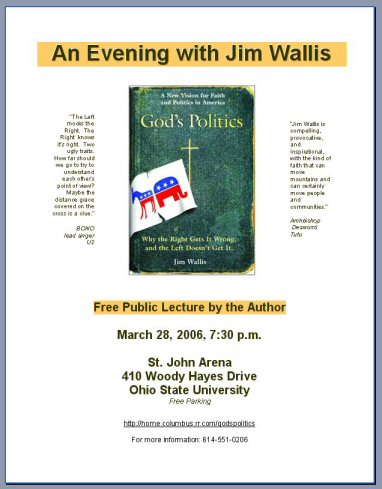
Jim Wallis Lecture/Discussion Tuesday, March 28

The link for this event has been in the sidebar pretty much since I started this blog, but since the lecture/discussion is now less than a week away, I felt I should do a post about it. Here are the basics...

A Public Lecture and Discussion on Faith, Values, and Politics

Purpose
To bring together a diverse group of individuals and groups interested in the role of faith and values in contemporary politics.

Date and Time
March 28, 2006 at 7:30 p.m.

Venue
St. John Arena
Ohio State University
410 Woody Hayes Drive
Columbus, Ohio

Entrance
No entrance fee. Open to all.

More links:


Downloadable flyer
Agenda for the evening
Map and directions

Alternate link for comments

Tuesday, March 21, 2006

Event: Faith and Politics in the U.S.: Two Evangelical Perspectives

Two Evangelical Perspectives: Jim Wallis Debates Russell Johnson This Sunday (March 26) in Columbus
When: 3:30-5:00 pm
Where: Capital Theater 77 South High St. Columbus, OH 43215
Who: Jim Wallis, founder of Sojourners and best-selling author of God’s Politics: Why the Right Gets it Wrong and the Left Doesn’t Get It and Rev. Russell Johnson, chairman of the Ohio Restoration Project.

Thanks to Upper Arlington Progressive Alliance for the heads-up about this event. I won't be able to attend, but would really like to be able to post first hand accounts from people who do. If you do attend the event in Columbus this coming Sunday and would like to submit your own summary and thoughts about it, you can e-mail me at ohiorenee at gmail.com.

More about the event, and some relevant links:
What: A one-hour dialogue between Jim Wallis and the Ohio Restoration Project chairman Russell Johnson on the role of faith in politics followed by a Q&A session.

Why: Our nation is hungry for an open dialogue on moral values and their role in the public square. The goal of this gathering is to discuss how various social issues—including abortion, poverty, the environment, advancing peace, and promoting strong families—are all critical moral and community values that can be approached from differing evangelical perspectives.


Here is a link to a flyer you can print out, and this link is where you can order free tickets for the event: www.sojo.net/townhall

Alternate link for comments

Saturday, March 18, 2006

Peace Rallies Today

Today there are a number of peace rallies planned to mark the third anniversary of the U.S.-led invasion of Iraq. If you attend one of these rallies and take pictures, I'd really love to have some to post. You can e-mail them to me at ohiorenee at gmail.com. Of course I'd also appreciate any write-ups of the event as well.

http://www.cpanews.org/march18/

Alternate link for comments

Friday, March 17, 2006

We are all "paralyzed" in some way

I've written here that, in the tradition of doing something extra during Lent rather than giving something up, I have decided to do some reflections not just in writing, but in an audio format. I just posted my second podcast/audioblog yesterday, and what follows is more or less the content of it (I discovered I pretty much end up having to write the whole thing out to avoid having to stop and restart too many times when recording.)


There is a Gospel reading and a sermon, that I've been thinking about for a few weeks, that I'd like to talk about today. A few weeks ago, the Gospel reading was the story of Jesus healing the paralytic. That Gospel, combined with the sermon preached by our seminarian in training that day, and something I heard later in the service really caught my attention that day. And in the days and weeks that followed, my mind kept returning to them. Let me start by sharing that Gospel reading, which many of you are probably familiar with, but just to have it fresh in your minds before I talk about it...
Jesus Heals a Paralytic
A few days later, when Jesus again entered Capernaum, the people heard that he had come home. So many gathered that there was no room left, not even outside the door, and he preached the word to them. Some men came, bringing to him a paralytic, carried by four of them. Since they could not get him to Jesus because of the crowd, they made an opening in the roof above Jesus and, after digging through it, lowered the mat the paralyzed man was lying on. When Jesus saw their faith, he said to the paralytic, "Son, your sins are forgiven."

Now some teachers of the law were sitting there, thinking to themselves, "Why does this fellow talk like that? He's blaspheming! Who can forgive sins but God alone?"

Immediately Jesus knew in his spirit that this was what they were thinking in their hearts, and he said to them, "Why are you thinking these things? Which is easier: to say to the paralytic, "Your sins are forgiven," or to say, "Get up, take your mat and walk"? But that you may know that the Son of Man has authority on earth to forgive sins . . . ." He said to the paralytic, "I tell you, get up, take your mat and go home." 1He got up, took his mat and walked out in full view of them all. This amazed everyone and they praised God, saying, "We have never seen anything like this!"

And Tara, our seminarian in training, went on to describe, first of all, what that scene would have looked like, the way houses were constructed in that time and place such that it was typical to have the roof easily accessible by some sort of stairs. (In fact, I had just seen a program about this on the National Geographic Channel.) And she drew a word picture of what the man's friends--the man who, though he is a major character in the story, never speaks a word, and who we have not heard ask for anything--what they had to go through to dig through the roof and lower him down. And then she drew a parallel to what we are called to do.

She said that we are *all* paralyzed in some way...physically, emotionally, spiritually etc.

We need to dig on behalf of our neighbors, get dirt under our fingernails and sweat on our brows, break through barriers on behalf of others.

It was a good sermon, like many good sermons I've heard at my progressive Episcopal church. But it probably wouldn't have stood out in my mind were it not for what happened next. During the Prayers of the People, a parishioner said, "For the health of Bishop Gene." It took a minute to place the name--Bishop who? Then I realized it must be Gene Robinson he was talking about. I hadn't heard anything about him having health issues, and wondered how serious it was.

So, I took out my Sidekick (phone with internet access) and did a quick web search Father forgive me, I have Googled in church and found out pretty quickly that Bishop Gene Robinson had recently entered a rehab facility for treatment of alcoholism. And one of the very first headlines I saw was on Worldnet Daily (for anyone who is not familiar, this is a very right wing internet "news" source" smugly proclaiming, "The homosexual, alcoholic bishop"

And I looked at that headline and thought, "You heartless, self-satisfied son of a--" Okay, I'm already feel a tad guilty about Googling during Mass--probably shouldn't make things worse with that kind of language. But it *really* made me angry. It was just so hateful--positively crowing with condescension.

And it came back to me, "we're *all* paralyzed in some way, and we need to dig through barriers on behalf of our neighbors. Even the those neighbors that are jerks.

And thinking about the different ways people can be paralyzed, it's a lot easier to want to help--to feel *moved* to help someone whose disability is physical and clearly visible. Even the paralytic in the Gospel story is not seen *asking* for help, but neither do we see him denying the need for help. Or worse, scorning those who might wish to help him. But then, that's why these things are called "barriers" isn't it?

One of the first things I read about Gene Robinson when I first heard of him was an interview in which he was asked who his favorite saints were. One of the people he named was Fred Rogers--known by several generations of children as Mister Rogers. That really caught my attention, since I think it was around that time that I really started reading more about Fred Rogers, the man and the Presbyterian minister. And the more I learned about him, the more impressed I became. After he died, his wife Joanne Rogers released a book entitled The World According to Mister Rogers, and part of the forward she wrote to the book was posted online:
A quote he loved especially-and carried around with him-was from Mary Lou Kownacki: "There isn't anyone you couldn’t love once you’ve heard their story." There were many times I wanted to be angry at someone, and Fred would say, "But I wonder what was going on in that person’s day." His capacity for understanding always amazed me.

That really stopped me in my tracks. I know *I* have come across as unkind or uncaring to people at one time or another, simply because I was stressed or preoccupied. I certainly would *like* for people to withhold judgement...so I keep reminding myself to try to do the same for others...to ask that question Fred Rogers routinely asked himself--what might be going on in that person's day.

And I *do* try. But it's harder when we're not talking about one day, but people for whom meanness seems to be a way of life.

This is from an article that appeared in Christianity Today in March of 2000
In seminary Mister Rogers studied systematic theology with Dr. William S. Orr. "From then on I took everything he offered; it could have been underwater basket weaving.

"He was a great influence on many of our lives. Not just because he was brilliant," he says. "He was the kind of person who would go out on a winter's day for lunch and come back without his overcoat.

"I studied Greek with him and then I studied New Testament with him. Every Sunday, my wife and I used to go to the nursing home to visit him. One Sunday we had just sung "A Mighty Fortress Is Our God" and I was full of this one verse. I said, 'Dr. Orr, we just sang this hymn and I've got to ask you about part of it.

"You know where it says-The prince of darkness grim, we tremble not for him. For, lo, his doom is sure. - one little word will fell him? Dr. Orr, what is that one thing that would wipe out evil?"

"He said, 'Evil simply disintegrates in the presence of forgiveness. When you look with accusing eyes at your neighbor, that is what evil would want, because the more the accuser'-which, of course, is the word Satan in Hebrew-'can spread the accusing spirit, the greater evil spreads.' Dr. Orr said, 'On the other hand, if you can look with the eyes of the Advocate on your neighbor, those are the eyes of Jesus.'

"I've never forgotten that."

I know in my heart that this is true, and I want to try to live my life accordingly, but I often seem to come up short. It's not easy. But I know that the other way, the way of punishment, revenge, and feeding our own hate, *really* doesn't work. In fact, it takes bad situations and makes them worse. So, I guess I just have to keep trying...with God's help.

Alternate link for comments

Wednesday, March 15, 2006

More photos

There are several good pictures of the We Believe launch now posted here.

Alternate link for comments

The We Believe launch in the news

From the Dayton Daily News:

Interfaith group launches social justice campaign
Plans to raise single voice on social justice issues
More than 300 people gathered Tuesday in Columbus' First AME Zion Church to celebrate the launch of We Believe Ohio, an interfaith group with the goal of making a unified cry for social justice heard in the public square.
...
"We believe people of faith are meant to build bridges, not construct barriers," said the Rev. Tim Ahrens, senior pastor of the First Congregational Church of Columbus and a leader of the group. "Rather than demonize those with differences, we believe God calls us to unite and heal, because we believe our God is a reconciling God."

The group now includes pastors, priests, rabbis, cantors and lay leaders, according to Ahrens. Goals include advocating for the poor and homeless and getting an 80 percent voter turnout from congregations. The group has set a meeting for April 23 to discuss the May 2 primary election.

Ahrens said We Believe would be open to meeting with Johnson and Parsley.

Parsley said the new group, like his, wants to care for the poor and disadvantaged. "There's common ground when we're holding the word of God that speaks to all these issues," he said.

From the South Mississippi Sun Herald:

New clergy group says it will leave picking candidates to voters
...
There will be no concern that We Believe Ohio is crossing the line between issue advocacy and endorsements, said the Rev. Allan Debelak of Redeemer Lutheran Church in Columbus, who also signed the IRS complaint.

"One of the great things about this country is we have that line. It maintains the role of government," Debelak said.

We Believe Ohio leaders say they want to unite people on contentious social issues including education, the economy and health care. The group's first goal is to turn out 80 percent of each congregation's registered voters to the polls this year.

The group is concerned that too many people of faith are listening for guidance in this year's election and all they are hearing is the religious right, said Berman, who has been at his temple for 27 years.

"What is going on at the moment involves some people feeling very strongly that voices need to be heard and there are different ways to do that," Berman said.

For the most part, the articles I've been finding have said a lot of the same things, but this snippet from a piece in the San Luis Obsipo Tribune answers a question I have heard a number of people ask:
While no firm plan is in place, the group is looking at ways to move beyond its core of central Ohio, Ahrens said. He took note when the group went shopping for an Internet address and found that "webelieve" wasn't available but "webelieveohio" was.

"We believe that God is good all the time. Maybe that's a message that others can join us," Ahrens said.

Alternate link for comments

Tuesday, March 14, 2006

The We Believe! launch today

I attended the launch event today, and as my husband and I circled the church in an attempt to find parking, I was pleased to see that a number of media outlets were in attendance. Will have to watch to see what sort of coverage it receives.

When we took our seats, I was horrified to discover that my voice recorder, which had plenty of juice left when I checked last night, now had dead batteries. I scrawled as many notes as I could, and I really do mean scrawled. If I try to write fast, I have some of the worst handrwriting in the world. That's why I *bought* the voice recorder.

So I need to try to decipher what I wrote before I can post anything here. In the meantime, I invite anyone who was in attendance and who would like to share some of their thoughts about today's event to e-mail me at ohiorenee @ gmail.com, and I can post your comments here as a guest entry. (Or, if you have some better pictures of the event that you'd like to share here, that would be great too!)

Also, if you see any good articles about today's event at The First AME Zion Church, please feel free to either e-mail me the link, or post it in the comments below.

Click this link to read We Believe's press release about today's event.

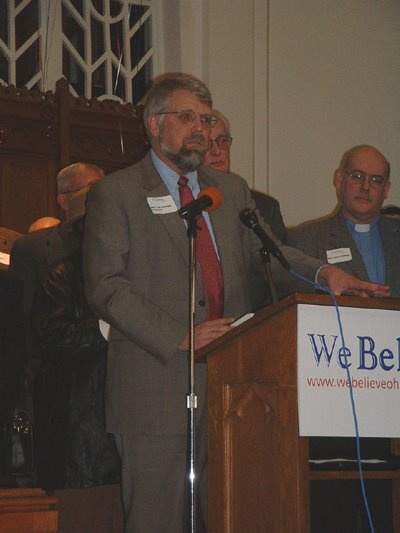
Cantor Jack Chomsky of Congregation Tifreth Israel (seen here at the microphone) led attendants in the song Horeni Hashem before the announcement/press conference portion of the event began, and later outlined the groups six action steps. (The rector of my church is the one directly to the right of the purple banner.)


We Believe
co-convener Rev. Eric Brown, Sr. Pastor of the Woodland Christian Church in Columbus presented the group's mission statement.

“God is calling us to reconcile people of faith. God calls us to unite and heal not to demonize our neighbors.” Rev. Tim Ahrens, First Congregational Church.

Rev. Richard Wing of First Community Church said the closing blessing.

Alternate link for comments

Sunday, March 12, 2006

We Believe! Ohio (update and reminder)

The launch of the group We Believe! Ohio, which I wrote about here, is now only two days away. They now have a web site, which you can link to by clicking the graphic below. If you've ever wondered aloud where were the moderate, sane religious leaders countering the far right, well, here they are. But they're going to need some help if they are to be heard.


On We Believe's About Us page it says:
We are black and white. We are men and women. We come from a wide range of theological diversity as well. We are conservative, moderate, and liberal on the spectrum of faith and public policy! We serve urban, suburban, and rural people in our houses of worship. We hold in common a deep and abiding love of the God whom we serve.

We also share in common our strong belief that we must act and speak in public ways to support the poor, the children, and those who are voiceless and unrepresented in our times.

Here is the where and when of the launch event/press conference:
Tuesday, March 14, 2006
11:00 AM
The First AME Zion Church
873 Bryden Rd. Columbus, OH

More details here, including printable PDFs you can use to share the details with people offline.

http://webelieveohio.org/images/Launch_Event.pdf
http://webelieveohio.org/launch_media_advisory.pdf

Alternate link for comments

Friday, March 10, 2006

Politics and the Pulpit (audio)

Via Upper Arlington Progressive Alliance:
After a liberal church was targeted by the IRS for preaching political views and threatened with its tax-exempt status, it lashed out and argued that some conservative churches could be in the same situation. This led to several conservative churches in Ohio being investigated by the IRS.

Host Barbara Bogaev talks with Ed Bacon, rector of All Saints, a liberal church in California, and Russell Johnson, pastor of the conservative Fairfield Christian Church, about IRS probes at their respective churches; and explores their political and religious differences and common ground.

Listen here.

Alternate link for comments

Thursday, March 09, 2006

Interfaith Prayer Service for Hope and Healing in Iraq

Interfaith Prayer Service:
Prayers of Hope and Healing for Iraq

On the 3rd year anniversary of the attack on Iraq, we will gather together again as communities of diverse faiths to:
- pray for peace in the world and in our country
- value all life as being precious in the eyes of a loving God
- raise concern for U.S. and Iraqi soldiers, as well as armed forces of other nations and civilians who have been killed or injured in Iraq, Afghanistan, and other areas of military conflict in the world
- repent for the Iraqi prisoner and detainee abuses

Saturday, March 18, 2006, 12:00 Noon

St. John's Evangelical Protestant Church
United Church of Christ
59 East Mound Street, Columbus, Ohio 43215
www.stjohnscolumbus.org

(March to Statewide Pro-Peace Rally at the Statehouse Begins at 1:15 PM From the Church)

Organized by:
Faith Communities Uniting for Peace
& Interfaith Association of Central Ohio