Monday, April 23, 2007

The church as a "public" institution

As I mentioned yesterday, the Diocese of Southern Ohio has a new bishop, and his consecration will be this Saturday. Bishop Katharine Jefferts Schori will come to Columbus to take part in the ceremony. So, ever since I knew this event was coming, it has been my intention to attend if at all possible. On Friday, I heard from my rector that there was indeed a ticket being held in my name. So, yay!

Well, maybe "yay" isn't quite the right word. I'm pleased that I will be able to attend, and I'm sure I'll be glad I did. But this is going to involve a number of things I *don't* particularly relish--crowds, trying to park at Ohio State, standing for extended periods of time...

Probably some incense, now that I think of it. (Wrinkles nose in anticipation)

Anyway, knowing that I had this event coming up, I knew couldn't pass up the opportunity to hear the bishop-elect speak at my church last night. And then, actually *having* something a little unique to blog about, I couldn't pass that up either, could I?

Tonight I'll share the first part of his talk, in which he addressed what it means for the church to be a public institution.

Rev. Breidenthal started by telling us that his most recent position was Dean of Religious Life at Princeton, which he said was a "fancy term for University Chaplain". Most of his work has been as a teacher in one way or another, with students of different ages and situations, and alongside other teachers. Speaking at St. Stephen's Episcopal Church and Univerisity Center, he said that it was a relief to be in a setting where he could say that proudly "without it being assumed that therefore I am unworldly". He noted that the university setting is, in fact, the intersection between many, many communities, where it is impossible to isolate oneself from the "real world".

About being "in communion": Communion is not a product of agreement, but has to do with staying at the table, respecting each other's arguments, and having reverence for the basic commitments that bring us together around the altar in the first place.

Breidenthal said that it was important for the church to be "public". When the Roman Christians emerged out of the catacombs, the first thing they did was build churches, and they built basilicas. He said these were the Roman version of today's mall--an enclosed forum with room for businesses, shops and vendors all around the edges, and a lot of space in the middle where public disputation could happen.

So it is significant that they, once they started to build churches, chose the basilica model, which was basically the agora, or public forum. Where God and God's people were interacting publicly and opening themselves to a world where there was really no reason you couldn't be part of that community as long as you were willing to be baptized. And to be baptized wasn't to enter a community, it was to be expelled from any community that was exclusive.

We tend to think of baptism as inclusion, but in fact, the primary metaphor of baptism is birth, and birth is about expulsion into something large and scary...and public. And so, the early Christians at their best--they were able to be as crabby and exclusive as we are--but at their *best*, they understood the Gospel to be utterly practical to the world. And they understood the church, not primarily as a refuge, as a place of withdrawal from the world and safety from the world, but they viewed the church as a people in exodus--in exodus out of all of their exclusive and closed communities. This is what it meant to define ourselves as a people who included all people, without exception. That every possible non-universal identity was transcended by membership in the church.

So, one reason why I think that campus ministry, and churches that have strong and intentional campus ministries, why that's so important, is because the university recalls the church through its initial public witness. And parishes like St. Stephen's help remind other parishes that may be in danger of becoming *just* extended families, that however small or suburban they may be, they are, each of them, a gateway into the whole world. I like to think of going to church as not going inside, but actually going through the doors into something outside.
More to come, as I find the time, on topics such as ecumenism and interfaith relations--the hard, but necessary work of coming together, respectfully, in our diversity.

Tuesday, March 27, 2007

"Radical welcome"

Last night I started to write up some of what Tanya Erzen said at the presentation she gave at my church the other night, which was about the two years she spent studying the "ex-gay" movement and how it fits into the agenda of the "Christian right". But, man, was some of that stuff depressing and anger-inducing. So I decided to share some other things first, which fit in with the notion of churches (and individuals) practicing "radical welcome".
Radical welcome kicks welcome to the next level. It asks, Who would never even come to the door, because they are so sure we will not receive them, and because, historically, we have not?
Click here to read Now *that's what I call "good news"!

Sunday, March 25, 2007

Interfaith Prayers for Peace

A Brethren Love Feast

When: Thursday, April 5, 2007, 12 noon - 1 PM
Where: St. Thomas More Newman Center (near OSU campus), 64 W. Lane Ave., Columbus OH 43201.
Phone: 291-4674, Ample free parking available in church parking lot

The April 5th prayer service will be a special Brethren "Love Feast" complete with foot-washing and communion, for the third year in a row. Come experience the Church of the Brethren's 4-fold communion in an open, interfaith setting. All are welcome as participants or observers; the Brethren belief of "no force in religion" applies both in life and in worship.

The worship service will be led by Dr. Verdena Lee, Columbus physician and national board member of On Earth Peace, an agency of the Church of the Brethren. Dr. Lee is also a member of Living Peace Church of the Brethren in Columbus. All are invited to attend.

We gather together as communities of diverse faiths to:
- pray for peace
- promote peace, harmony, restraint, and interfaith understanding, and
- foster unity among people in Central Ohio and around the world.

Sponsored by
Faith Communities Uniting for Peace

Faith Communities Uniting for Peace is a gathering of people of faith, prompted by the war on Iraq, to find common ground, encouragement and wisdom for the transformation of the world. The organization affirms that "all faiths call followers to live and speak with peace, justice and compassion," and commits itself to putting our faith values into action.

Members of Faith Communities Uniting for Peace include persons affiliated with several faith groups (American Baptist, Baha'i, Buddhist, Church of the Brethren, Episcopal, Friends, Hindu, Islamic, Jewish, Lutheran, Mennonite, Presbyterian, Roman Catholic, Sikh, United Church of Christ, and United Methodist) as well as other people of conscience.

Saturday, March 24, 2007

From the Episcopal Diocese of Southern Ohio:

The House of Bishops met this week at Camp Allen in Texas for their regular spring meeting. The main topic of the meeting was to respond to the Primates' Communique issued in February. They crafted a letter called a Message for God's People that explained their collective response to the Communique. They also developed "Mind of the House" resolutions and issued an invitation to the Archbishop of Canterbury to meet with a group of the bishops and discuss the issues.

Southern Ohio's Bishop-elect Tom Breidenthal and Bishop Ken Price offer their reflections on the House of Bishops meeting. Click here to read Bishop Price's response. Click here to read the Bishop-elect's response. They also encourage folks to use this forum as a place to talk about the events this week -- and about other issues in the diocese.

Wednesday, March 21, 2007

Soup and Study at St. Stephen's

From the church newsletter of Saint Stephen's Episcopal Church...

Sunday Soup and Study meets again on March 25. As the final session on Christianity in America: the Present, Assistant Professor Tanya Erzen, Department of Comparative Studies, OSU, will talk about the religious right and its impact on society. From her biographical statement: "Her research interests include American Religion with a focus on Christianity and Evangelicalism, religion, gender, and sexuality; religion and American politics, American social movements, and the Christian Right." Her 2006 book Straight to Jesus is subtitled Sexual and Christian Conversions in the Ex-Gay Movement. Supper begins at 5:30, the program at 6:15 ending at 7:30. The fee for this single session is $8.00. Students are welcome free of charge.

Saint Stephen's is on the campus of The Ohio State University
30 West Woodruff Avenue, Columbus, Ohio 43210

From Salon.com: Gay, godly and guilty

The thoughtful new book "Straight to Jesus" reveals the torment suffered by gay Christians who entered a residential program to battle their sexual desires.
Click here to hear Tanya Erzen on NPR's Fresh Air (taped in October of 2006)

From National Sexuality Resource Center, an article by Tanya entitled Straight to Jesus: Sexual and Christian conversions in the ex-gay movement

A Columbus Dispatch article from June 2006: Rejecting gay feelings, some strive to change

And from Free and Responsible Search,
Tanya Erzen is an ethnographer who did her dissertation field work at New Hope Ministry, a California program devoted to "healing" gay men of their homosexuality. In other words, she plunged right into the heart of the Christian Right and set up shop in a West-pointing Temple of the Sunrise. If you can stand it, her new book Straight to Jesus: Sexual and Christian Conversions in the Ex-Gay Movement is a crash course on the worldview of conservative Christianity.

Wednesday, March 14, 2007

From We Believe Ohio

Just two days before the release of Governor Strickland's proposed budget, We Believe Ohio held a press tele-conference to call on both the administration and the State Assembly to maintain civility in the budget negotiation process, and to keep the focus on the most vulnerable citizens in the state. Clergy leaders of We Believe Ohio also specifically called on the administration and State Assembly to work together to expand health care coverage for the more than one million uninsured Ohioans and to comply with the Supreme Court's mandates on public education.

* You can read the press release by visiting:
http://www.webelieveohio.org/press/pressr11307.html

* Individual Statements from We Believe leaders who were on the call can be found at : http://www.webelieveohio.org/press/teleconferencestatements.html

During the call, We Believe also announced plans for a "Day of Prayer and Action," when clergy and lay leaders from across the state will lobby the administration and legislature. Additional details regarding the May 3 event will follow in the coming weeks!

To learn more about the State budget, please Please join us at one of our March meetings:

In Columbus:
March 22, 8:45-11:00 a.m. at Congregation Tifereth Israel, 1354 E.
Broad St., Columbus Ohio 43205

In Cleveland:
March 29, 7:00-9:00 p.m. at Trinity Cathedral, 2230 Euclid Ave,
Cleveland, Ohio 44115

War protest at National Cathedral

This action alert is from Faith in Public Life


3,500 Christian Leaders from 48 States to Protest War at National Cathedral, Mass Arrests Expected at White House

(Washington, DC) – Christian Peace Witness for Iraq will begin with a worship service on Friday, March 16 at Washington National Cathedral to be attended by more than 3,500 people of faith from 48 states, followed by a candlelight procession through the center of our nation’s capital, where thousands will surround the White House bearing the light of peace, and 700 will risk arrest by remaining in prayer in front of the White House. The service begins at 7 p.m., and the White House vigil will begin at 10:30 p.m. It will be the largest Christian peace demonstration, as well as the largest single civil disobedience action at the White House, since the beginning of the Iraq war four years ago.

More than 190 Christian and interfaith peace vigils and actions will also be held around the country in conjunction with Christian Peace Witness for Iraq-- including large-scale acts of moral civil disobedience organized by Christian Peace Witness coalition member group the Declaration of Peace .

WHAT: Christian Peace Witness National Cathedral Worship Service, Procession and Action at White House

WHEN: March 16, 2007 at 7pm

WHERE: The National Cathedral
Massachusetts and Wisconsin Avenues, NW
Washington, D.C. 20016-5098

WHO: Features speakers include:

Rev. Jim Wallis, founder of Sojourners/Call to Renewal and author of God’s Politics

Taylor Branch, Pulitzer Prize-winning author of America in the King Years and a Presbyterian Elder

Rev. Raphael Warnock, Pastor, Ebenezer Baptist Church, Atlanta, Ga.

Dr. Bernice Powell Jackson, President of the North American Conference of the World Council of Churches.

Rick Ufford Chase, convener of Christian Peace Witness for Iraq’s steering committee and former Moderator of the General Assembly of the Presbyterian Church.

Celeste Zappala, a United Methodist and founding member of Gold Start Families Speak Out, whose son was killed in Iraq in April 2004

SPONSOR ORGANIZATIONS: Adventist Peace Fellowship, American Friends Service Committee, Baptist Peace Fellowship of North America, Brethren Witness, Catholic Peace Fellowship, Christian Alliance for Progress, Christian Peacemaker Teams, Declaration of Peace, Disciples Justice Action Network, Disciples Peace Fellowship, Episcopal Peace Fellowship, Every Church a Peace Church, Faith in Public Life; Kairos: A Time to Speak, A Time to Act; Kirkridge Retreat and Study Center, Leadership Conference of Women Religious, Lutheran Peace Fellowship, Maryknoll Office for Global Concerns, Methodist Federation for Social Action, Peace and Justice Support Network of Mennonite Church USA, National Council of Churches, No2Torture, On Earth Peace, Pace e Bene Nonviolence Service, Pax Christi USA, Pentecostal Charismatic Peace Fellowship, Presbyterian Peace Fellowship, Protestants for the Common Good, Sisters of Mercy of the Americas, United Church of Christ Justice and Witness Ministries, Sojourners/Call to Renewal.

Monday, March 05, 2007

The meaning of a "Black Value System"

This is related to my post about A Black Theology of Liberation from the other day. In addition to the overview link I posted, I had also looked at a PDF that went into detail about what is meant by a Black Value System. This part stood out to me, and I think I heard it echoed when listening to Barack Obama speaking at an event in Selma commemorating the voting rights march that took place there 42 years ago.

Disavowal of the Pursuit of "Middleclassness"


Classic methodology on control of captives teaches that captors must keep the captive ignorant educationally, but trained sufficiently well to serve the system. Also, the captors must be able to identify the "talented tenth" of those subjugated, especially those who show promise of providing the kind of leadership that might threaten the captor's control.


Those so identified as separated from the rest of the people by:


Killing them off directly, and/or fostering a social system that encourages them to kill off one another.


Placing them in concentration camps, and/or structuring an economic environment that induces captive youth to fill the jails and prisons.


Seducing them into a socioeconomic class system which while training them to earn more dollars, hypnotizes them into believing they are better than others and teaches them to think in terms of "we" and "they" instead of "us".


So, while it is permissible to chase "middle-incomeness" with all our might, we must  avoid the third separation method-the psychological entrapment of Black "middleclassness": If we avoid the snare, we will also diminish our "voluntary" contributions to methods A and B. And more importantly, Black people no longer will be deprived of their birthright, the leadership, resourcefulness, and example of their own talented persons.


Anyway, I thought that excerpt was worthy of some reflection. In yesterday's post, I linked to the lively exchange between Sean Hannity and Barack Obama's pastor, the Rev. Dr. Jeremiah Wright, about whether Trinity United Church of Christ espoused a "radical separatist" agenda. What I failed to mention at the time is that I do "get" why many White people are uncomfortable with the wording Hannity referred to from the church's web site--commitment to the Black family, the Black community, etc. Hannity asked, wouldn't it sound racist if you substituted the word White--if there was a church that openly stated it was all about supporting and strengthening the White community.


And I can't judge him for asking that. I've wondered the same thing in the past. Wright responded that churches have been that way for ages--White by default. White is "generic" to many of us, so we don't even use the word as a descriptor when we are describing a new person we met, for example.  But that's not an easy concept to "get".  It's going to take some serious thoughtful discussion among people of good will. Which means, and this is just a guess, it will likely be taking place somewhere other than Sean Hannity's television program.

Saturday, February 17, 2007

Soup and Study at St. Stephen's in Columbus

From the Saint Stephen's Episcopal Church newsletter:

Sunday Soup and Study continues looking at Christianity in America: The Present. On February 18, our guest will be the Rev. John S. Paddock, Rector of Christ Church, Dayton, a church in an urban center. He and his parish are focused on issues of poverty, racism, homelessness, and economic decline. Christ Church - like St. Stephen's - is a member of The Center for Progressive Christianity. The title of his talk is "With Fingers Crossed Behind My Back: How A Progressive Christian Recites the Creed."


Friday, February 16, 2007

Just doing what the voices tell me...

I used that line the other night in response to someone who has tried to "reason" with me about the futility of my latest internet project. I was being tongue in cheek, but I was also referring to something I've addressed before, in my story God, the Blue Puppy. As the mother of young children who watched Blue's Clues, I enjoyed the idea that God left little "clues" to let me know when I was on the right track toward fulfilling the purpose She has in mind for me.

Of course, now that my kids are 11 and 13, that show is a distant (sometimes pleasantly nostalgic) memory, so I don't talk about "God's Clues" any more. But from time to time I do feel "called", for lack of a better word, to take action. How do I know it's something I'm meant to do? 1. It feels out of character and scary. 2. The damn thing just won't go away. So, while I don't have a name for that insistent feeling that there is something I must do, there is an image/metaphor that seems to pop into my mind: Joan of Arc. Of course, the big problem with that...

...is that for Joan, it led to this.


And, you know, I am so not into that.

Of course I'm being metaphorical here--I don't expect to be barbecued. "Flamed" perhaps, in the good old-fashioned usenet sense, or potentially banned or reprimanded, depending on the site. Because the issue I currently feel that I must do something about, was spurred by the Orwellian-ly named Blogroll Amnesty Day. But it's not just about medium to small blogs being purged from the blogrolls of the "big dog" bloggers. It's about the increasingly evident consolidation of power that can be seen in some of the top ranking blogs. That's just wrong in my mind. The blogosphere has such potential to be truly democratic. As I wrote yesterday,

But the blogroll purge which, as I have already stated, does not affect me personally, has been the catalyst that prompted me to revisit some of these issues. Also an overarching issue that I have noticed over time: the man really tries to have it both ways. On the one hand, he's been quoted as saying that he is "not a leader" or that he's "just a guy with a blog". But on the other hand, he has often behaved like a very autocratic guy who just "happens" to have one of the most widely read blogs on the Democratic side of the aisle. And he has a great degree of power over what issues can see the light of day in front page posts.


This was starting to remind me of the situation with the mainstream media. They were controlled by interests other than "we the people", and they were too willing to play along with Bush during the buildup to the war in Iraq. They were also silent for far too long about the election integrity issues that many of us saw a mile away.


Anyway, in addition to work, digging out from the snow, and just generally the day to day responsibilities of an ordinary American who does *not* have ad space worth $9000 a week needs to keep up with, this is what I've been working on lately...

Read the point of view of the smaller bloggers on "Blogroll Amnesty Day"

Saturday, February 03, 2007

We Believe Conference--more to come

I received an e-mail from Heather, who does the web site at We Believe, that there will be minutes forthcoming, so those of us who couldn't attend the retreat, or who, like me, had to leave early, can be kept in the loop. In the meantime, I wanted to post a link to the keynote address Rev. Tim Ahrens gave in Washington D.C. at Faith in Public Life's Faith Leadership Meeting, which took place in December. He read the first part of it aloud to us at the meeting earlier this week, and it was the first time I'd heard it...
The day after the midterm elections, Katie Barge and I talked by phone. With her encouragement, I sat down and wrote these words:

This morning the sun rose once again over beautiful Ohio. It was, perhaps, one of the most beautiful sunrises I have seen here.

Yesterday, rain fell and a steady wind swept through our land. The rain brought cleansing. The wind brought change to our state. The change came in political offices. But, much more so, the wind blew through the hearts and minds of people who courageously stepped forward to vote their values. People stepped in the polls in 88 counties and said, "We believe the working poor deserve a hand up. We believe gambling is no way to pay for our children̢۪s education. We believe that smoke free air and a healthy environment is better for us than smoke-filled rooms." People said, "We believe in standing up for justice and against elected officials who 'stay the course' even when no one can tell what the course is and where we are going."

Today, I am proud to be a Christian leader in Ohio. I am proud of those in all faith traditions with whom I stand to make a brighter and more beautiful future. We love God with our whole hearts, minds, and souls. We love our neighbors as ourselves. We are multi-cultural and multiracial. We are bridge builders. We love humanity and don't seek to demonize others. We are faithful and moral to the core of our souls. But we will not impose our faith and morality on others.

We are uniting people everywhere and we are united in this effort. We are and will continue to be ones who seek to heal the world. We will not be silent. We will listen to the voice of God guiding us forward in faith and action.

Today, I stand in the sunshine of this state beaming with delight. I stand among all Ohioans who braved the wind and the rain yesterday to make a change. I am humbled to be counted among those, who on a rainy, windswept day lifted their heads, walked into the prevailing winds stood courageously and voted for a change - determined to show God and one another that wind itself could change.

On November 7th, The people of Ohio demonstrated the audacity to hope! Ohioans heard the cries of the poor and answered. Ohioans spoke out against corruption and greed. Ohioans stood up from the midst of the mud-slinging in this campaign season and declared, "We see what we need to do . . . and we will do it!" Today, in the sunshine of God's love, we step forward. That is what I see today as I soak in the sunlight. We believe in God. We believe in Ohio.
Click here for the rest.

Tuesday, January 30, 2007

A prayer for the new year

Originally posted elsewhere on December 31, but I wanted to share it here as well. And it is still January, so here goes...


Holy Mother...Loving Father...
Source of All That Is...
Oh--You know who You are!

That daughter You gave me said a funny thing yesterday:
"It seems like God has gotten shy over the years"
(Meaning You don't talk to people like in the "old days")

I said I wasn't sure that was true--
that sometimes it just doesn't get written down
Sometimes people aren't sure it's really You
(Or are afraid to believe that it is)

And I told her of the time I heard from you
(or one of Your "people")
"Help heal the world" were the words I heard
while lying in bed early that morning
And then You held me close

Maybe I imagined that, but it didn't matter
The words felt real enough, and the need for healing was real,
so I promised that I would
Later I learned about tikkun olam,
the Hebrew phase which translates to "repairing the world"

That confirmed the notion that the call to help heal the world was true and real...

It's also impossible

There can never be enough glue, tape, bandages, needles and thread, hammers and nails, hope, patience, and love, to get the job done

I suppose that's why the baptismal vows say, "I will, with God's help"

So as we begin a new year, I ask again for Your help
Help me to find the strength, energy, and love to keep working
to mend that which is broken,
both in myself and in the world You entrusted to our care.

We Believe Leadership Retreat

I attended part of the We Believe Leadership Retreat today. I wasn't planning to stay over night, but I had hoped to at least stay all of today, but I was really nervous about the idea of trying to drive home from hilly, snowy, unfamiliar Belville, Ohio IN THE DARK. And it turned out I couldn't get any signal at all on my cell phone, so I had no way of contacting family to let them know I'd arrived safely. And my husband had no way of getting any important information to me.

So I headed home, even though I was really looking forward to continuing the discussion, which was to include issues such as:
Among the issues to be considered and moderated at the retreat:
*Are we a Movement—or an Organization?
*How do the answers to those questions affect our structure and our plan?
*How do we broaden our circle?
When I arrived home, I was met an increasingly more challenging situation with Son in Ohio's school that needs to be dealt with, and the news that I need to report to work tomorrow rather than Monday, which is what I'd been told yesterday.

Anyway, the reason I'm going into this much detail about things is that it speaks to that goal of "How do we broaden our circle?" I very much support the mission of We Believe and would like to be part of it. So one goal *I* would have for the organization would be multiple ways of keeping people "in the loop" if they aren't able to attend meetings and such. So, for starters, if anyone who attended the conference would be willing to fill me in about what I'm missing by not attending the last 2/3 of the event, I would be most grateful.

Saturday, January 27, 2007

Douglas Adams speech excerpt

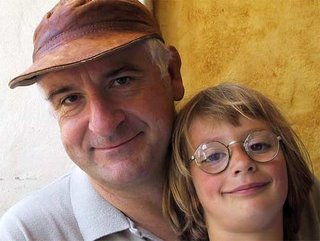
The following is an excerpt from the Douglas Adams video I linked to in this post. Since I can't get a screen capture from the video, I'm including this image of Douglas Adams with his daughter, Polly.


The conclusion of Adams' talk on endangered species:

There is a kind of terrible irony that at the point that we are best able to understand and appreciate and value the richness of life around us, we are destroying it at a higher rate than it's ever been destroyed before. And we are losing species after species after species, day after day, just because we're burning the stuff down for firewood. And this is a kind of terrible indictment of our understanding.

But, you see, we make another mistake, because we think somehow, this is all right in some fundamental kind of way, because we think that this is all sort of "meant to happen".

Now let me explain how we get into that kind of mindset, because it's exactly the kind of mindset that the kakapo gets trapped in. Because, what has been a very successful strategy for the kakapo over generation after generation for thousands and thousands of years, suddenly is the wrong strategy. And he has no means of knowing, because he is just doing what has been successful up till then. And we have always been, because we're toolmakers, because we take from our environment the stuff that we need to do what we want to do and it's always been very successful for us--

I'll tell you what's happened. It's as if we've sort of put the "pause" button on our own process of evolution, because we have put a buffer around us, which consists of medicine and education and buildings, and all these kinds of things that protect us from the normal environmental pressures. And, it's our ability to make tools that enables us to do this.

Now, generally speaking, what drives speciation, is that a small group of animals gets separated out from the main body by population pressure, some geographical upheaval or whatever. So imagine, a small bunch suddenly finds itself stranded ina slightly colder environment. Then you know, over a small number of generations that those genes that favor a thicker coat will come to the fore and you come back a few generations later, and the animal's got a thicker coat.

Man, because we are able to make tools, we arrive in a new environment where it's much colder, and we don't have to wait for that process. Because we see an animal that's already got a thicker coat and we say we'll have it off him. (Laughter.)

And so we've kind of taken control of our environment, and that's all very well, but we need to sort of be able to rise above that process. To rise above that vision and see a higher vision--and understand the effect we're actually having.

Now imagine, if you will, an early man, and let's see how this mindset comes about. He's standing, surveying his world at the end of the day. And he looks at it and things, "This is a very wonderful world that I find myself in. This is pretty good. I mean, look, here I am, behind me is the mountains, and the mountains are great. Because there are caves in the mountains where I can shelter, either from the weather or from bears that occasionally come and try to attack me. And I can shelter there, so that's great. And in front of me is the forest, and the forest is full of nuts and berries and trees, and they feed me, and they're *delicious* and they sort of keep me going. And here's a stream going through which has got fish in it, and the water's delicious, and everything's *fantastic*.

And there's my cousin Ug. And Ug has caught a mammoth! Yay!! (Clapping). Mammoths are terrific! There's nothing greater than a mammoth, because you can wrap yourself in fur from the mammoth, you can eat the meat of the mammoth, and you can use the bones of the mammoth, to catch other mammoths!

Now this world is a fantastically good world for him. And, part of how we come to take command of our world , to take command of our environment, to make these tools that we need, is that we ask ourselves questions all the time. So this man starts to ask himself questions. "This world" he asks himself, "so, who made it?" Now, of course he thinks that, because *he* makes things himself, so he's looking for someone who will have *made* this world. "So, who would have made this world?" he thinks. "Well, it must be something a little bit like me. Obviously *much much* bigger, and (glancing up) necessarily invisible, but he would have made it. Now, *why* did he make it?"

Now, we always ask ourselves "why" because we look for intention around us, because *we* do things with intention. We boil an egg in order to eat it. So, we look at the rocks and we look at the trees, and we wonder what intention is here, even though it doesn't have intention. So we think, what did this person who made this world intend it for. And this is the point where you think, "Well, it fits *me* very well. You know, the caves and the forests, and the stream, and the mammoths. He must have made it *for me*!"

I mean, there's no other conclusion you can come to. And it's rather like a puddle waking up one morning--I know they don't normally do this, but allow me, I'm a science fiction writer (laughter). A puddle wakes up one morning and thinks "Well, this is a very interesting world I find myself in. It fits me very neatly. In fact, it fits me *so* neatly, I mean, *really* precise, isn't it? (Laughter) It *must* have been made to have me in it!" And the sun rises, and he's continuing to narrate the story about this hole being made to have him in it. The sun rises, and gradually the puddle is shrinking and shrinking and shrinking, and by the time the puddle ceases to exist, it's still thinking, it's still trapped in this idea, that the hole was there *for* it. And if we think that the world is here *for us*, we will continue to destroy it in the way in which we have been destroying it, because we think we can do no harm.

There's an awful lot of speculation one way or another at the moment, about whether there's life on other planets or not. Carl Sagan, as you know, was very keen on the idea that there *must* be. The sheer numbers dictate, because there are billions and billions and billions, as he famously did *not* say, in fact, of worlds out there, so the chance must be that there's other intelligent life out there. There are other voices at the moment saying that if you look at the circumstances here on earth, they are *so* extraordinarily specific that the chances of there being something like this out there, are actually pretty remote.

Now, in a way it doesn't matter. Because think of this--Carl Sagan, I think, himself, said this. There are two possibilities: either there is life out there on other planets, or there is no life out there on other planets. They are both *utterly* extraordinary ideas! But, there is a strong possibility that there isn't anything out there remotely like this. And we are behaving as if this planet, this *extraordinary*, utterly, utterly extraordinary little ball of life, is something we can just screw about with any way we like.

And maybe we can't. Maybe we *should* be looking after it just a little bit better. *Not* for the world's sake--we talk rather grandly about "saving the world". We don't have to save the world--the world's fine! The world has been through five mass extinctions. Sixty-five million years ago when, as it seems, a comet hit the earth at the same that there were vast volcanic eruptions in India, which saw off the dinosaurs, and something like 90% of the animals on the planet at the time. And another 150 million years earlier than that, another giant, giant, giant extinction. The world has been through it many times before, and what tends to happen, what happens invariably after each mass extinction, is that there's a huge amount of space available, for new forms of life suddenly to emerge and flourish into. Just as the extinction of the dinosaurs made way for us. Without that extinction, we would not be here.

So, the world is fine. We don't have to save the world--the world is big enough to look after itself! What *we* have to be concerned about, is whether or not the world we live in, will be capable of sustaining *us* in it. *That's* what we need to think about. Thank you very much, ladies and gentlemen. (Applause).

Thursday, January 11, 2007

"America Says No" Rallies

So, whatever happened to the notion that "Elections have consequences"? George W. Bush, after his narrow "victory" over John Kerry in 2004, claimed that he had a mandate to press forward with his agenda, rather than trying to work in a more bipartisan manner. You know, "Reach across the aisle"? Apparently that is only considered an admirable trait when it's Democrats that are in power.

The midterm elections have been described by many as being driven largely by public dissatisfaction with the war in Iraq. From those elections to any public opinion poll I've seen, the message from the American public has been a resounding "No!" to the Bush administration's strategy in Iraq. Bush's response has been the equivalent of sticking his fingers in his ears and yelling "La la la la la!"


For anyone who is not aware of this...
Volunteers will host actions in cities and towns across the country within 24 hours of the president’s speech with a simple message: "America says NO more troops in Iraq!”

I will be the first to admit that I am tired of trying to oppose a president who is so bound and determined to ignore and isolate any voices outside of his small circle of "yes men" (and women). Do I believe that we can change his mind on the escalation of the war in Iraq, announced last night in a special address to the nation? Sadly, no.

But the world is watching us, and I think it would be a sad commentary on American apathy if these rallies were sparsely attended. What does that say to people in other nations (who used to hold our country in such high regard) if our response to Bush acting in direct opposition to our will, is, "Yeah, whatever."

Click here to find a vigil or rally in your area.

Friday, December 29, 2006

On Poverty

I strongly recommend reading Christy Hardin Smith's post Bringing Poverty to the Table. Yes, as I suspected, the post was prompted by Edwards' announcement yesterday. But even if you support a different candidate, please read. As Christy noted at the end of the piece:
That it has taken a Presidential candidate standing up and talking about this issue to get it back on the front pages of newspapers — at least for the day yesterday — is unconscionable. But at least people are talking about it again, and for that I applaud John Edwards for sticking to a topic that all of us need to be talking about much more frequently.
I don't have a candidate to support yet, as Gore still seems unwilling to run, Feingold has said he won't, and Howard Dean is a man of his word, who promised not to run if elected chair of the DNC. But poverty is one of those uncomfortable, dauntingly big and complex issues that tends to get swept under the rug by the majority. Maybe it's a bit like global warming in that respect. Hurricanes Katrina and Rita were graphic examples of the urgency of both issues--we can't afford to ignore either. So I will join Christy in applauding Edwards getting poverty back into the headlines, even for one day. But I hope it will be for longer than that. Hopefully other candidates and officeholders will join him.

And I don't say this as a supporter of any political candidate. I say it as a human being. I also say it as an Episcopalian who is proud of my new Presiding Bishop who insists on keeping the focus on this issue, in spite of the efforts of others to shift the attention back to issues of human sexuality. From an interview in June of 2006:

Bishop JEFFERTS SCHORI: We need to be examining the poverty that is real around the world. We need to be examining the fact that our brothers and sisters, Anglican and not, in places like Africa and Asia don't have enough to eat. Their children don't have the opportunity to go to school. AIDS and tuberculosis and malaria are rampant in many parts of this world and people with those diseases don't have access to adequate health care. That's where our focus needs to be.

And, from a description of Katharine Jefferts Schori's book, scheduled to be released in January...
Grounding her reflections in a theology of the reign of God—‘God’s dream for creation’—she dares to ‘dream big’ herself, casting a vision of a world without poverty and hunger, where we all recognize our interdependence with every other child of God.
Jefferts Schori's book can be preordered here.

And I have heard those words echoed by Bishop Gene Robinson, and by Archbishop Desmond Tutu, and by many other people I respect and admire. I hope that more and more people will talk about it--especially people who have an audience. And when people try to distract us with something shiny, I hope that we will redirect, and bring the discussion back to issues of vital importance for our human family.

(Also posted at Daily Kos, My Left Wing and Street Prophets)

Friday, December 22, 2006

Countering Anti-Muslim bigotry

Note: I started this post at the beginning of the month and then got very busy with Christmas preparations and various events for the kids. But today, after more recent developments, such as Virginia Represenative Virgil Goode's letter about the importance of tightening immigration restrictions to avoid an "influx of Muslims", I decided I'd better post it.

What I wrote earlier this month...

From Yahoo News: In U.S., fear and distrust of Muslims runs deep

When radio host Jerry Klein suggested that all Muslims in the United States should be identified with a crescent-shape tattoo or a distinctive arm band, the phone lines jammed instantly.

Another said that tattoos, armbands and other identifying markers such as crescent marks on driver's licenses, passports and birth certificates did not go far enough. "What good is identifying them?" he asked. "You have to set up encampments like during World War Two with the Japanese and Germans."

At the end of the one-hour show, rich with arguments on why visual identification of "the threat in our midst" would alleviate the public's fears, Klein revealed that he had staged a hoax. It drew out reactions that are not uncommon in post-9/11 America.
A video of news segment about this story can be seen at Crooks and Liars.

Here is a link to some columns by Dr. Asma Mobin Uddin, a Columbus area pediatrician and member of the Muslim faith. She makes public appearances (one at my church a couple years ago) to help people learn more about the misunderstood and sometimes mistrusted faith to which she belongs, has written columns for the Faith and Values section of the Columbus Dispatch, and has written a children's book, My Name is Bilal...
Synopsis:
Bilal worries about being teased by his classmates for being Muslim. He thinks maybe it would be better if people don't know he is Muslim. Maybe it would be best if he tells kids his name is Bill rather than Bilal. Then maybe they would leave him alone. Mr. Ali, one of Bilal's teachers and also Muslim, sees how the boy is struggling. He gives Bilal a book about the first person to give the call to prayer during the time of the Prophet Muhammad. That person was another Bilal: Bilal Ibn Rabah. What Bilal learns from the book forms the compelling story of a young boy wrestling with his identity.

We Believe Conference

Quick post--it's Christmas time and all, but I wanted to post a link to this before I forgot again...

Moving Faith Forward
We Believe Leadership Retreat!
January 30-31, 2007

Saturday, November 11, 2006

Sister Helen Prejean at St. Stephen's in Columbus

On Sunday, November 12 at 7 p.m. Sr. Helen Prejean, author of Dead Man Walking and The Death of Innocents will speak at St. Stephen’s Episcopal Church. She is also the founder of the Moratorium Campaign, a group seeking to halt the death penalty

30 West Woodruff Avenue
Columbus, Ohio 43210
Parking available at ARPS garage
614-294-3749.
Free will offering

You can read more about Helen Prejean here:
Sister Helen Prejean: The real woman behind 'Dead Man Walking'
Sister Helen Prejean's Personal Web Site

Friday, October 20, 2006

David Korten in Columbus, October 14, 2006

This is the beginning of my transcription of David Korten's remarks at the Earth Charter Summit that took place in Columbus, Ohio on Saturday, October 14.

It is such a joy to be here in Ohio with such a great group of people --I've just been meeting extraordinary activists everywhere I go. And, I hope you'll excuse me if I just take a moment here to go shake hands with Granny D (laughter and applause). Granny D is such an inspiration, when I was facing my 65th birthday and thinking, "Well, you know, this is kind of a transition. I guess the rest of my life I should be starting to think about winding down and passing on the responsibilities." (Laughter) And Granny D of course is an extraordinary example of what we should all be doing with our elder years. She's a great inspiration.

Now, I'm also fascinated by your politics here. Dennis Kucinich is one of my heroes--one of the most visionary politicians of our time. (Applause). And of course I note that you cover the range, to a candidate for governor who really should be in the penitentiary. Anyhow, hopefully he will find his way to the appropriate outcome.

This is a very special weekend here, I'm sure you know this is one of four sets of activities by different initiatives. And of course the Earth Charter and the Earth Charter Summit is what brings together the visionary framework for all of the rest of our work. And I'm so pleased that the Earth Charter folks here in Columbus are framing the issue in terms of creating earth community, because that, to me, is really the way to frame the Earth Charter. That it presents the principles for the earth community that we must bring forth. And that gives the substance and the lead-in to action.

And then of course the other initiaives, CIRCA, which is focussed on ending corporate colonization--that is one essential step on the path to earth community. Then Simply Living, which working on, "Okay, how do we implement it in the way we live, the way we organize our living space? The way we organize our economies."

The key to this is positive. As was mentioned in the introduction, one of the things I've come to is resistance alone is a losing strategy. Ultimately, to win we must come forward to create the positive.

And then of course the fourth, and absolutely foundational element of this quadrangle is the Voting Rights Revival. And of course Ohio here reminded us all that, among all the democratic reforms we need, it starts with counting the votes. Absolutely foundational. So, I congratulate you all on your work, and thank you for the invitation. I hope my comments today will help put the work you're doing in a deeper historical, cultural, and to some extent spiritual context.

Now, the underlying message of the Great Turning is quite straightforward. We humans have come to the end of a long and deeply destructive era. It is time to turn this world around for our own sake, and for the sake of our children for generations to come.

There's good news and bad news, and it comes in the same package. The news is "business as usual is over". Peak oil, climate change, the collapsing U.S. dollar, and spreading social disinigration born of the marginalization of the majority of humanity are coming together in a constellation of forces desined to fundamentally change every aspect of modern life.

Now, whether this convergence of forces plays out as an epic human opportunity or the final human tragedy, will depend on the stories by which we understand what's happening, and undrestand the choices that it is ours to make. And I'm going to be talking about those choices.

(More to come)